
In This Issue




Designing Fall Prevention That Sticks: Digital Coaching and the Neuromechanics of 'Timber Falls'
A randomized trial of a self-managed balance app and new neuromechanics research are reshaping how we think about preventing falls in older adults — and why some topple backward like felled trees.
Falls are the quiet productivity tax of later life — the one event that can turn an independent parent into a hospital admission overnight. For decades, the prevention playbook has been clear in theory and frustrating in practice: balance and functional exercise works, but only if people actually do it. Two new pieces of research, one a randomized trial of a self-managed exercise app and the other a neuromechanics study of why some older adults fall backward like timber, suggest the next chapter in fall prevention will be defined less by what we prescribe and more by how intelligently we deliver it.
- Digital balance coaching is plausible, not proven. A year-long randomized trial of the Safe Step app found measurable signals but stopped short of a definitive fall-rate verdict.
- Adherence is the real bottleneck. Self-managed home programs only work when people keep using them — the hard part technology is trying to solve.
- Not all falls are the same. New research identifies 'Timber falls' — backward topples driven by delayed muscle response — as a distinct pattern in older adults with mild cognitive impairment.
- Mechanism matters. Knowing why someone falls (slow muscle onset vs. altered coordination) opens the door to targeted, not generic, training.
- Ask a clinician first. Apps and at-home programs are adjuncts to, not replacements for, individualized assessment.
The adherence problem, repackaged
Exercise programs that combine balance and functional training have long been the most evidence-backed intervention for reducing falls in community-dwelling older adults. The catch has always been delivery. Group classes require transportation; physiotherapy visits require referrals and copays; and even motivated participants tend to drift away from home programs within months. Researchers behind the Safe Step randomized controlled trial, published in the Journal of Medical Internet Research, set out to test whether a self-managed digital app could carry that load.
The trial enrolled community-dwelling adults aged 70 and older who had either fallen in the past year or noticed their balance slipping. Participants were randomized to one of two arms: the Safe Step app paired with educational videos, or educational videos alone. Both interventions ran for a full year, with monthly self-reported fall diaries and quarterly check-ins on exercise adherence. It is a pragmatic design — closer to how the technology would actually be used than to a tightly supervised lab protocol.

Self-managed apps shift responsibility — and the burden of consistency — onto the user.
What the trial actually showed
The honest read on the Safe Step results is that they are encouraging without being conclusive. The study modeled fall rates using negative binomial regression and fall risk using logistic regression — the right tools for the messy, count-based reality of fall data — and tracked attrition and adherence alongside the primary outcomes. As with most year-long digital interventions, the signal lives or dies on whether participants keep opening the app in month nine.
That is exactly why this trial matters more than a single effect size suggests. It is one of the first rigorous tests of a fully self-managed, unsupervised digital balance program in the population that actually needs it: older adults already showing the early markers of fall risk. Whatever the precise magnitude of benefit, the design tells us something about feasibility, dropout patterns, and the kinds of injuries that occur even within an actively exercising group.
Whatever the precise effect size, the question the field is finally asking is the right one: can a phone keep someone exercising for a year?
Why some people fall backward like trees
While the digital-delivery question plays out, a separate line of research is asking something more fundamental: why, exactly, do certain older adults fall in certain ways? A 2025 study in GeroScience zeroed in on a striking pattern the authors call the 'Timber' fall — a backward topple caused by reactive stepping that arrives too late, or not at all, after a sudden loss of balance.
The researchers exposed 36 older adults with mild cognitive impairment (OAwMCI), 38 cognitively intact older adults, and 20 young adults to a large forward-directed stance perturbation while recording muscle activity from the hamstring, quadriceps, calf, and shin. Timber falls — defined as failing to initiate a step within 430 milliseconds and ending up with more than 30% of body weight caught by a safety harness — occurred only in the cognitively impaired group. Within that group, 36% were Timber fallers; 64% stepped intact.
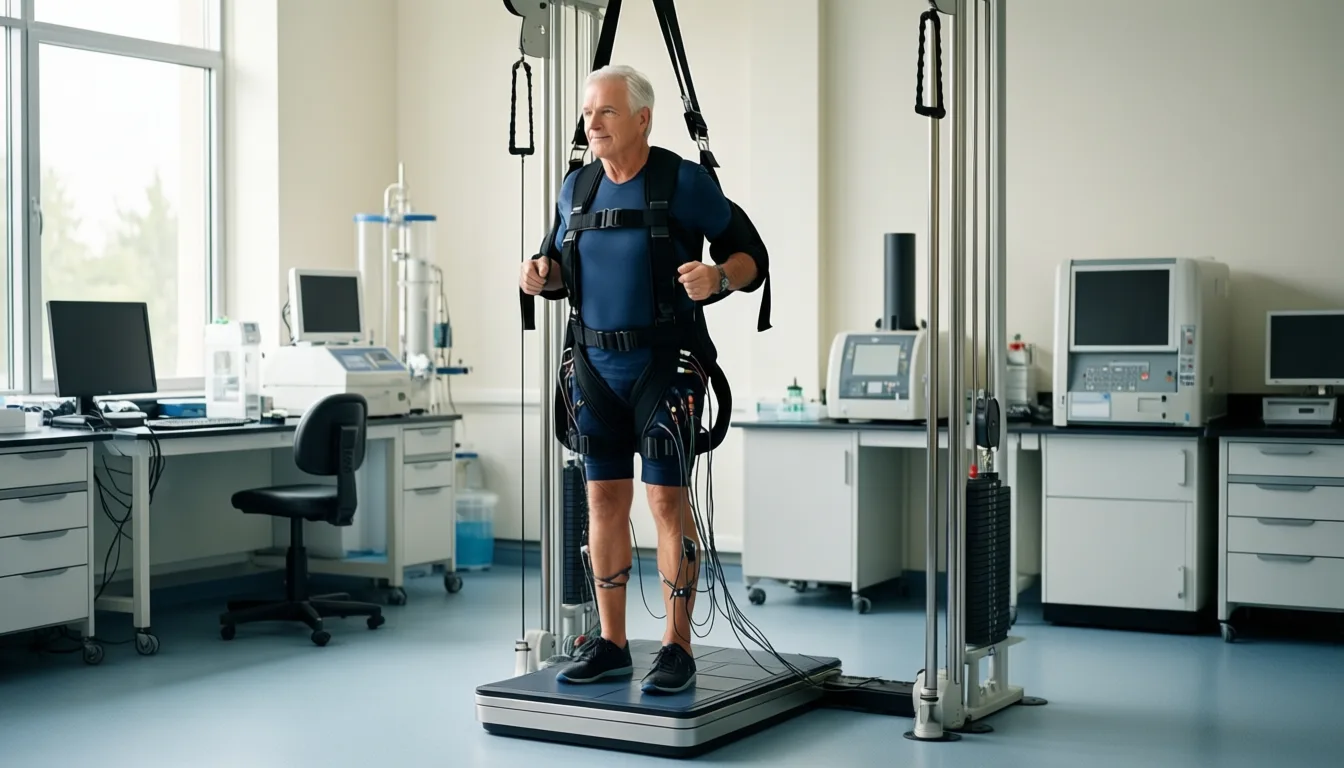
In the lab, a sudden platform shift reveals who can step in time — and who cannot.
Initiation, not execution
The team's central question was diagnostic: when a Timber fall happens, is the failure in starting the protective step or in executing it? Their data point toward initiation. Timber fallers showed longer step initiation times, shorter step lengths, lower reactive stability, and altered muscle onset latencies and synergies compared with peers who stepped successfully. The body knows the recipe; the start signal arrives late.
That distinction is more than academic. Generic 'do more balance work' advice treats all reactive deficits the same. If the bottleneck is response initiation — a delay between perturbation and the first muscle firing — then training that explicitly rehearses fast reactive stepping under unpredictable conditions becomes the priority, particularly for older adults with mild cognitive impairment.
The convergence: smarter, mechanism-aware prevention
Read together, these two studies sketch a more sophisticated approach to fall prevention than the field has historically offered. The Safe Step trial argues that delivery is a solvable problem — that a well-designed app can plausibly keep older adults engaged with balance training at scale. The Timber falls research argues that what we deliver should depend on the underlying neuromechanical signature. A program tuned for a cognitively intact 72-year-old recovering from a stumble may not be the right program for a 78-year-old with mild cognitive impairment whose protective stepping arrives 200 milliseconds late.
The future hinted at by both papers is not heroic. It is the unglamorous combination of consistent practice and the right kind of practice, mediated by tools that can meet people where they live.
The bottom line for busy families
For readers managing their own aging or a parent's, the practical signal is moderate but real. A self-managed digital balance program is a reasonable thing to ask a clinician about — particularly when the alternative is doing nothing because the nearest class is 40 minutes away. And as research like the Timber falls study continues to break 'fall risk' into mechanistically distinct subtypes, expect the next generation of these apps to get more specific: less generic balance content, more targeted reactive-stepping drills for the people whose nervous systems need them most.
The headline is not that technology has solved falls. It is that the question has finally narrowed from 'does balance training work?' to 'how do we get the right kind of balance training to the right person, often enough to matter?' That is a much better question.
Frequently asked questions
What exactly is a 'Timber fall,' and how is it different from other falls?
A Timber fall is a backward topple caused by reactive stepping that arrives too late, or not at all, after a sudden loss of balance. In the research it was defined as failing to initiate a protective step within 430 milliseconds and ending up with more than 30% of body weight caught by a safety harness. Unlike a generic stumble, the failure is specifically in the start signal — the body knows how to step, but the initiation is delayed.
Who is most at risk for Timber falls?
In the study described in the article, Timber falls occurred only among older adults with mild cognitive impairment, and within that group 36% were classified as Timber fallers while 64% were able to step successfully. Cognitively intact older adults and young adults in the same experiment did not experience Timber falls.
What did the Safe Step app trial actually show?
The article describes the results as 'encouraging without being conclusive.' The year-long randomized trial compared a self-managed balance app paired with educational videos against educational videos alone in adults aged 70 and older who had fallen in the past year or noticed balance changes, but stopped short of a definitive verdict on fall rates. The trial's main value, according to the article, lies in what it reveals about feasibility, dropout patterns, and adherence.
Why is adherence described as the real bottleneck in fall prevention?
The article explains that while balance and functional exercise programs are well-supported, delivery has always been the problem — group classes require transportation, physiotherapy visits require referrals and copays, and even motivated participants tend to drift away from home programs within months. Self-managed apps shift the burden of consistency onto the user, and the article notes that the benefit of a digital program 'lives or dies on whether participants keep opening the app in month nine.'
Should someone use a fall-prevention app instead of seeing a clinician?
According to the article, app-based programs and at-home routines are adjuncts to, not substitutes for, individualized evaluation. The article specifically recommends that anyone who has fallen in the past year, noticed balance changes, or has been diagnosed with mild cognitive impairment start with a clinician-led fall-risk assessment, which would also include medication review and vision and footwear checks.
Sources
- Effectiveness of the Safe Step Digital Exercise Program to Prevent Falls in Older Community-Dwelling Adults: Randomized Controlled Trial. — Journal of medical Internet research
- Neuromechanistic causes of timber falls in older adults with mild cognitive impairment: Is response initiation or motor execution the problem? — GeroScience

The Brain Pollution Bombshell: Could Alzheimer's and Parkinson's Really Begin in Childhood?
A provocative review of brain tissue from young Mexico City residents argues that ultrafine air pollution may seed neurodegeneration decades before symptoms appear. The evidence is moderate — but hard to unsee.
Here is the sentence I did not expect to be writing at breakfast: the brain changes we associate with Alzheimer's and Parkinson's may not start in your 60s. According to a 2025 review in Toxics, they may start in kindergarten — in children breathing the air of one of the world's most polluted megacities. The authors examined neuropathology in young residents of Metropolitan Mexico City and concluded that ultrafine particulate matter (UFPM) and industrial nanoparticles are quietly setting the stage for neurodegeneration decades before anyone forgets a name or develops a tremor. It is a bombshell of a claim. It is also, importantly, one paper — and it deserves to be read with both eyes open.
If you are a woman in your 40s already side-eyeing your perimenopausal brain fog and wondering which of your habits to blame, I have annoying news: the air outside your window may belong on the list, too. The Toxics review argues that the long-running story we tell about dementia — that it is essentially a disease of aging, with a genetic nudge and some lifestyle seasoning — is incomplete. The authors propose a different framing: neurodegeneration as a lifelong environmental exposure disease, with the first pathological footprints laid down in childhood.
Their evidence comes from autopsy studies of children, teenagers and young adults from Metropolitan Mexico City (MMC), a region of 22 million people where fine particulate pollution routinely exceeds international guidelines. In those young brains, the researchers describe early markers consistent with Alzheimer's, Parkinson's, frontotemporal lobar degeneration (FTLD) and amyotrophic lateral sclerosis (ALS) — diseases we normally diagnose half a century later.
What is actually in the air
The villain in this story is not the smog you can see. It is the fraction you cannot. PM2.5 — particles smaller than 2.5 micrometers — is the pollutant most regulators track. The U.S. EPA's annual standard sits at 9 μg/m³, and the review notes that billions of people live above that line.
But the authors are most worried about something smaller still: ultrafine particulate matter (under 0.1 micrometers) and engineered industrial nanoparticles. These are small enough to slip past the body's usual defenses — through the nose, along the olfactory nerve, across the blood-brain barrier — and lodge in neural tissue. And here is a detail that should bother all of us: the U.S. does not routinely measure UFPM. We are, in effect, not looking.
The review's central provocation: the exposures that matter most may begin before first grade.
Why this is a moderate-evidence story, not a settled one
Time for the no-BS part. This is a review — a synthesis of the authors' own and others' work, concentrated in a single, uniquely polluted population. It is neuropathology, not a randomized trial (which would be ethically impossible anyway). It cannot prove that any individual child's exposure caused any specific later disease, and it does not tell us the threshold at which risk meaningfully climbs for people living in, say, a U.S. suburb with cleaner air.
What it does do is connect a dot that has been hovering on the edge of the literature for years: that the brain is an exposure organ, and that the assumption that you need to reach old age to develop neurodegeneration may simply be wrong. The authors call those early pediatric changes irreversible — strong language, and a claim that other researchers will need to test in other cities and other cohorts before we treat it as established fact.
So: take this seriously. Do not take it as a diagnosis.
The paradigm of reaching old age to have neurodegeneration is no longer supported. Calderón-Garcidueñas et al., Toxics, 2025
What this means if you are 35 to 50
Most readers of this magazine are not raising children in Mexico City. But the underlying biology — tiny particles, persistent exposure, a brain that does not forget — does not respect borders. Wildfire seasons are lengthening. Highway-adjacent housing is the norm for millions. Gas stoves, diesel idling, industrial corridors: the modern exposure portfolio is real, even where it is invisible.
The honest translation of this review for a 42-year-old reader is not panic. It is perspective. Brain health is a multi-decade project, and the environmental contribution to that project deserves a seat at the table next to sleep, movement, blood pressure and hormones. None of the standard advice changes. What changes is the why.
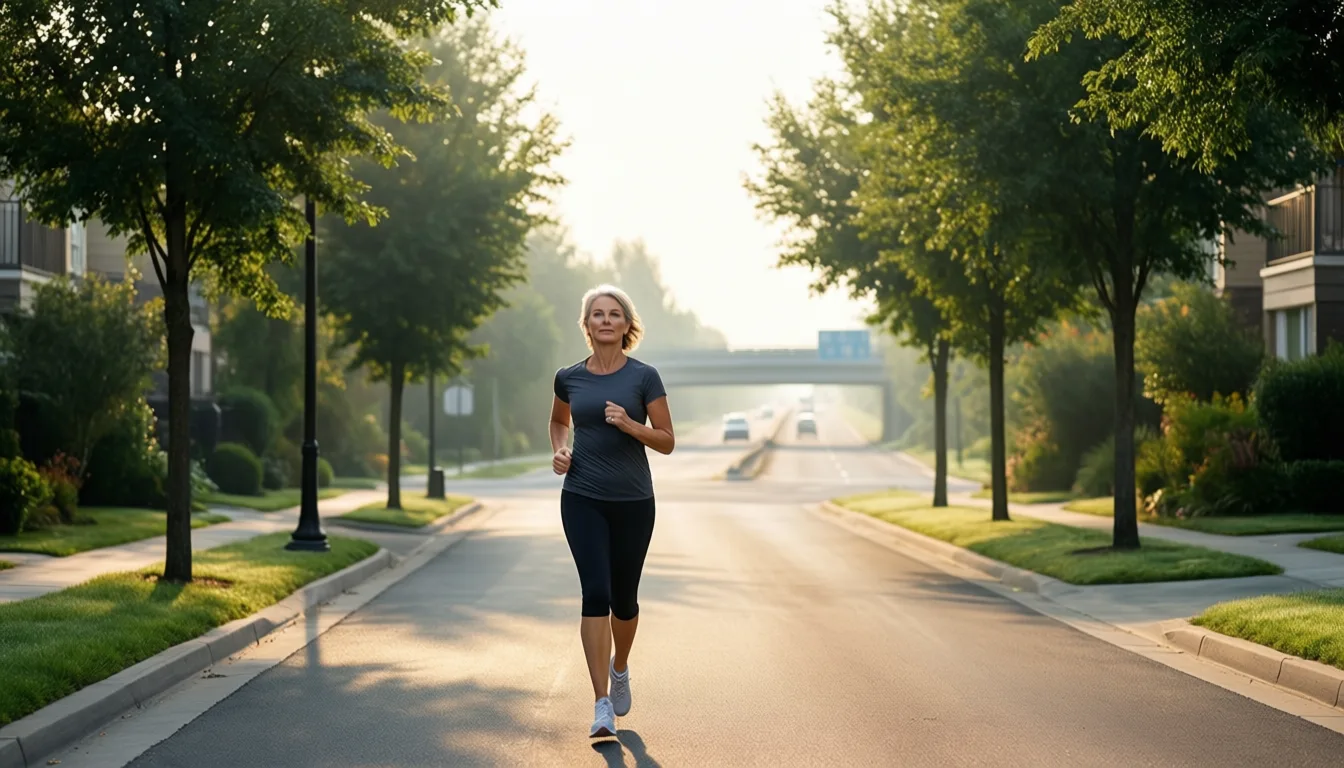
Routing a run through tree cover rather than along a freeway is a small exposure decision with a plausible long arc.
- The claim: A Toxics review argues Alzheimer's, Parkinson's, FTLD and ALS pathology can begin in childhood in highly polluted environments.
- The mechanism: Ultrafine particles and industrial nanoparticles appear able to reach and disrupt brain tissue in ways larger PM2.5 does not.
- The caveat: This is a review concentrated in one extreme-exposure city — moderate evidence, not proof for the general population.
- The blind spot: The U.S. does not routinely monitor ultrafine particulate matter, so personal risk is hard to quantify.
- The practical move: Treat air quality as a long-term brain-health variable — not a crisis, not an afterthought.
- The clinician conversation: If you have a strong family history of neurodegeneration plus high exposure, raise it at your next visit.
The bigger argument
Strip away the alarming headline and the review is really making a policy argument dressed as a pathology paper: if neurodegeneration is partly an environmental disease that starts in childhood, then waiting until age 70 to intervene is the wrong clock. The authors' closing line — it is time to invest in preventive medicine — is not subtle.
Whether the pediatric-origin claim holds up in other cities and other labs is the question the next few years of research will have to answer. In the meantime, the most defensible response is the least dramatic one: keep doing the boring, well-evidenced things that protect your brain, and add cleaner air to the list of things you advocate for — for yourself, and for the kids who will inherit whatever atmosphere we leave them.
Frequently asked questions
What neurodegenerative diseases does the review suggest may begin in childhood?
The 2025 review in Toxics identifies early markers consistent with Alzheimer's, Parkinson's, frontotemporal lobar degeneration (FTLD), and amyotrophic lateral sclerosis (ALS) in the young brains studied. These are diseases normally diagnosed roughly half a century later in life.
How do ultrafine particles reach the brain, and why are they more concerning than standard air pollution?
Ultrafine particulate matter (under 0.1 micrometers) and engineered industrial nanoparticles are small enough to slip past the body's usual defenses — traveling through the nose, along the olfactory nerve, and across the blood-brain barrier to lodge in neural tissue. Standard PM2.5, the pollutant most regulators track, does not behave the same way.
Does this research prove that air pollution causes Alzheimer's or Parkinson's?
No. The article is clear that this is a review concentrated in a single, uniquely polluted population and cannot prove that any individual child's exposure caused any specific later disease. It represents moderate evidence, not settled proof, and the authors' claims about early pediatric brain changes being irreversible will need to be tested in other cities and cohorts before being treated as established fact.
Why is it difficult to quantify personal risk from ultrafine particulate matter in the United States?
According to the article, the U.S. does not routinely measure ultrafine particulate matter, meaning the country is, in effect, not looking at the pollutant the review considers most worrying. This blind spot makes personal risk hard to quantify for Americans.
What practical steps does the article suggest for reducing air-pollution exposure?
The article recommends checking local air quality index (AQI) on bad days and moving workouts indoors, using a well-rated HEPA filter in the bedroom if you live near heavy traffic, ventilating when cooking especially with gas, and discussing cumulative occupational and residential exposure with a primary care clinician — particularly if neurodegenerative disease runs in your family.

Senotherapeutics 2.0: A Reishi Molecule, Rapamycin's Shadow, and the AI Hunt for Anti-Aging Drugs
A reishi-derived compound matched rapamycin in worms and rejuvenated aged mice. A parallel review maps how machine learning is industrializing the search for the next generation of senolytics.
For two decades, rapamycin has been the benchmark against which every aspiring longevity drug is measured — the molecule that bent the lifespan curve in worms, flies, and mice, and made geroscience a serious discipline. So when a team of Chinese researchers reported in Nature Communications this year that a compound extracted from the reishi mushroom extended lifespan and healthspan in C. elegans as effectively as rapamycin, the claim deserved a careful look. What they found is one of the more interesting preclinical signals of the year — and a useful case study in how the senotherapeutics pipeline is being rebuilt around high-content screens and machine learning.
The compound is ganoderic acid A, or GAA, a triterpenoid that gives Ganoderma lucidum its bitter edge and much of its traditional reputation. Reishi has been a staple of East Asian herbal pharmacopeias for centuries, which is exactly the kind of provenance that should make a longevity reader cautious: the gap between ethnobotanical folklore and a validated geroprotector is wide, and littered with overhyped extracts. What is different here is the route by which GAA surfaced. The Chen et al. team did not start with reishi; they started with a high-content screen for compounds that suppress markers of cellular senescence at low toxicity, and GAA emerged from that funnel.
Senescent cells are the central villain of modern geroscience. They stop dividing but refuse to die, accumulate in aged tissues, and secrete a stew of inflammatory signals — the senescence-associated secretory phenotype, or SASP — that drives much of the functional decline we associate with getting older. Drugs that selectively kill these cells (senolytics) or quiet their secretions (senomorphs/senostats) are collectively called senotherapeutics, and they are arguably the most active frontier in translational longevity research.
What the mushroom molecule actually did
In C. elegans, GAA extended both lifespan and healthspan to a degree comparable with rapamycin — the appropriate framing here is parity in a worm model, not superiority in humans. The mouse data are where things get more textured. The investigators tested GAA in three separate aging models: mice given irradiation to induce premature aging, naturally aged mice, and mice fed a Western diet to drive metabolic decline. Across all three, GAA reduced the accumulation of senescent cells and blunted physiological decline across multiple organs, and aged mice on the compound showed improved physical function and better metabolic flexibility.
Mechanistically, the team reports that GAA binds directly to TCOF1, a nucleolar protein involved in ribosome biogenesis, and that this interaction helps maintain ribosome homeostasis — a pathway increasingly implicated in cellular senescence. That is a more specific molecular story than most natural-product longevity claims offer, and it gives the finding something to be falsified against.
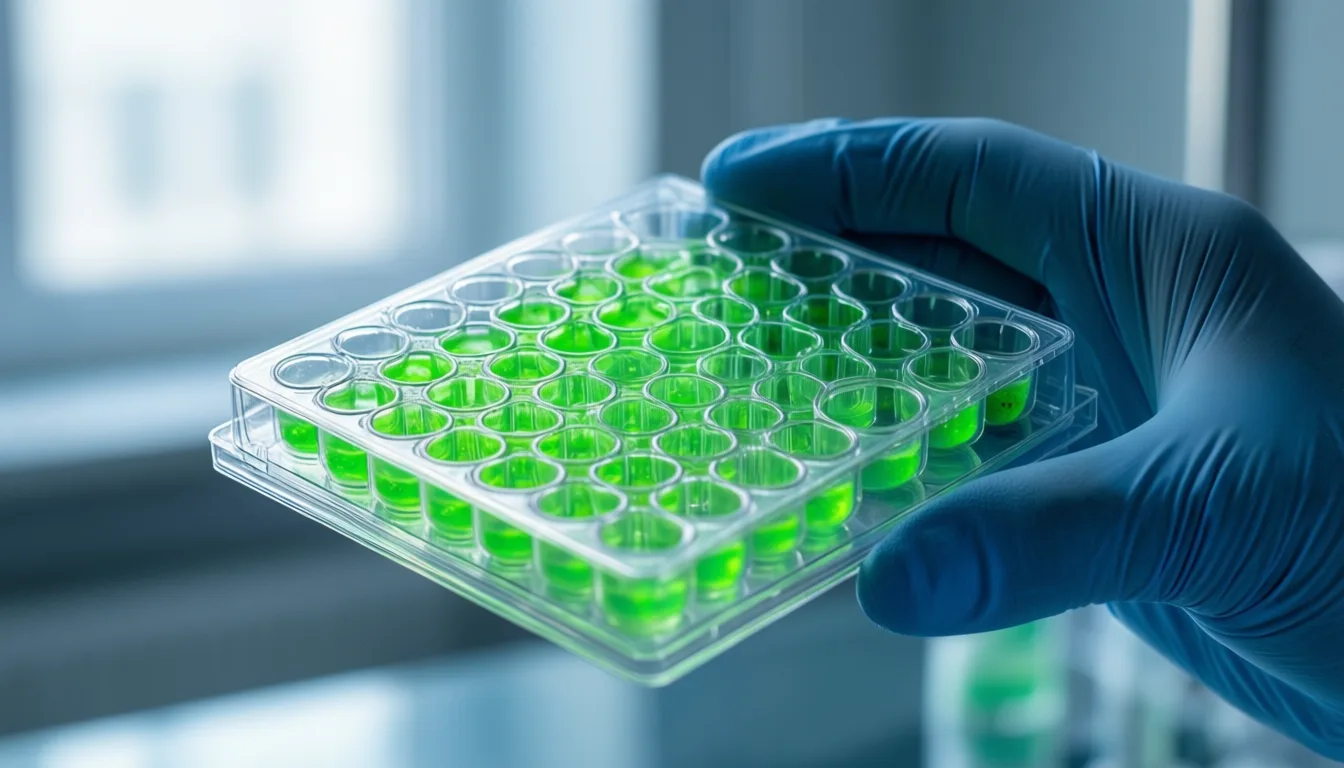
High-content screening — imaging thousands of compound-treated cells at once — is what surfaced GAA from a crowded field of candidates.
Parity with rapamycin in a worm is a headline. Parity in a human is a hypothesis. On reading preclinical longevity data
The bigger shift: AI is rebuilding the pipeline
GAA is interesting on its own, but it is more interesting as an artifact of how senotherapeutic discovery is changing. A parallel 2025 review in Advances in Pharmacology lays out the broader picture: the field is moving from hand-curated candidate lists toward machine-learning-driven discovery using random forests, support vector machines, neural networks, and predictive modeling, layered on top of omics data and phenotypic screens.
The review is candid about why this matters. Senotherapeutic translation has been hampered by three persistent problems: the absence of clean biomarkers for senescence, fragmented understanding of the molecular pathways linking senescent cells to disease, and a thin pharmacopeia of selective drugs. AI/ML tools attack all three by triaging huge compound libraries, integrating multi-omics signatures of senescence, and surfacing candidates a human curator would miss. The review also flags the obvious caveats — data quality is uneven, model interpretability is a real bottleneck, and predictive performance in a screen does not equal efficacy in a patient.
Read together, the two papers describe a maturing pipeline rather than a breakthrough drug. High-content phenotypic screening picks GAA out of a haystack; mechanistic work pins it to TCOF1; mouse models suggest broad-spectrum effects; and the methodological scaffolding around all of this is increasingly computational. It is the kind of compounding infrastructure that, over a decade, tends to produce real drugs.

Machine-learning models are increasingly the first filter through which candidate senotherapeutics pass.
What this means for a longevity reader in 2026
The honest framing is this: GAA is a credible preclinical signal, not a clinical recommendation. Worms are not people. Mice given a defined, characterized compound at a defined dose by trained investigators are not consumers buying reishi extracts of variable potency from the wellness aisle. The dose, formulation, and purity used in the published work are not the dose, formulation, or purity in any commercial supplement, and human pharmacokinetics, safety windows, and chronic-use effects for GAA at geroprotective levels have not been established.
The intellectually exciting part is what the paper implies about the search process. If a high-content screen can pull a previously-overlooked triterpenoid out of a natural-product library and pin it to a specific ribosomal-homeostasis mechanism, the same approach — accelerated by the ML methods catalogued in the companion review — is likely to surface more candidates with cleaner profiles than the first-generation senolytics like dasatinib-plus-quercetin or fisetin.
- Preclinical only. GAA's lifespan and healthspan effects were shown in worms and mice; no human trial data exist yet.
- Rapamycin parity is in worms. The comparison is meaningful as a benchmark, not as a clinical claim.
- A real mechanism. GAA binds TCOF1 and helps maintain ribosome homeostasis — a specific, testable hypothesis.
- Three mouse models, consistent direction. Irradiated, naturally aged, and Western-diet mice all showed reduced senescent-cell burden.
- The pipeline is the story. AI/ML-driven discovery is reshaping how senotherapeutic candidates are found and prioritized.
- Don't self-prescribe. Commercial reishi supplements are not the studied compound at the studied dose; discuss any longevity intervention with a clinician.
Frequently asked questions
What is ganoderic acid A, and how was it identified as a potential longevity compound?
Ganoderic acid A (GAA) is a triterpenoid extracted from the reishi mushroom (Ganoderma lucidum) that gives it its bitter edge and much of its traditional reputation. It was not identified by starting with reishi; instead, it emerged from a high-content screen designed to surface compounds that suppress markers of cellular senescence at low toxicity.
What does it mean that GAA showed 'parity with rapamycin,' and why is that comparison limited?
In C. elegans (roundworms), GAA extended both lifespan and healthspan to a degree comparable with rapamycin — the appropriate framing is parity in a worm model, not superiority in humans. The article is explicit that parity with rapamycin in a worm is a headline, while parity in a human remains a hypothesis.
What mouse models were used in the GAA research, and what did they show?
Researchers tested GAA in three mouse aging models: mice given irradiation to induce premature aging, naturally aged mice, and mice fed a Western diet to drive metabolic decline. Across all three, GAA reduced the accumulation of senescent cells and blunted physiological decline across multiple organs, with aged mice also showing improved physical function and better metabolic flexibility.
What is the molecular mechanism by which GAA is thought to work?
The research team reports that GAA binds directly to TCOF1, a nucleolar protein involved in ribosome biogenesis, and that this interaction helps maintain ribosome homeostasis — a pathway increasingly implicated in cellular senescence. The article notes this is a more specific molecular story than most natural-product longevity claims offer.
Can someone take commercial reishi supplements to replicate the effects seen in this research?
The article cautions that commercial reishi supplements are not the studied compound at the studied dose, noting that the dose, formulation, and purity used in the published work differ from what is available in the wellness aisle. Human pharmacokinetics, safety windows, and chronic-use effects for GAA at geroprotective levels have not been established, and no human trial data exist yet.
Sources
- High-content screening identifies ganoderic acid A as a senotherapeutic to prevent cellular senescence and extend healthspan in preclinical models. — Nature communications
- Next-gen senotherapeutics: AI/ML-driven strategies for aging and age-related disorders. — Advances in pharmacology (San Diego, Calif.)