
In This Issue




Lipoprotein(a): The Cardiovascular Risk Factor Guidelines Now Say to Measure Once
European, Canadian and U.S. lipid guidelines now endorse a one-time Lp(a) test for every adult. Here's why a number you inherit at birth is finally getting its moment in the cardiology clinic.
For decades, the standard cholesterol panel has shaped how clinicians think about heart risk: total cholesterol, LDL, HDL, triglycerides. But a separate, genetically determined particle has been quietly circulating in roughly one in five adults at levels high enough to meaningfully raise the odds of a heart attack, stroke, or narrowed aortic valve. Its name is lipoprotein(a) — written Lp(a) — and after years of clinical hesitation, three major lipid guidelines now agree it deserves a one-time measurement in every adult.
The shift is captured in a 2025 clinical rationale paper in the European Journal of Preventive Cardiology, which lays out the case that Lp(a) meets the established criteria used to judge whether any new test belongs in routine population screening. The authors argue that measuring Lp(a) once is no longer a niche specialist's tool but a piece of preventive medicine that should sit alongside the standard lipid panel — a position now endorsed by the European and Canadian lipid guidelines and by the National Lipid Association.
What changed is not the particle itself — Lp(a) was first described in the 1960s — but the strength of the evidence linking it causally to disease. Large genetic studies using a method called Mendelian randomization, which exploits the random inheritance of gene variants to mimic a randomized trial, have shown that people who inherit gene variants producing higher Lp(a) levels go on to develop more atherosclerotic cardiovascular disease and more calcific aortic stenosis. That signal holds across ethnicities, which matters because Lp(a) distributions differ substantially between populations.
Why this particle is different
Lp(a) looks superficially like LDL — the familiar "bad cholesterol" — but with an extra protein, apolipoprotein(a), wrapped around it. That structural quirk appears to make it more atherogenic per particle than LDL, and it also seems to promote inflammation and possibly clotting in vessel walls. Crucially, your Lp(a) level is roughly 80–90% determined by the gene you inherited. It barely budges with diet, exercise, or the statins that lower LDL. For most people, the number you have at 25 is, give or take, the number you'll have at 65 — which is exactly why a single lifetime measurement is enough.
The rationale paper frames the clinical stakes bluntly: in people with markedly elevated Lp(a), the lifetime cardiovascular risk is comparable to that of untreated familial hypercholesterolemia — a well-known inherited cholesterol disorder that cardiology has taken seriously for decades. The difference is that familial hypercholesterolemia gets flagged because LDL is on every lab panel. Lp(a), historically, has not been.

Lp(a) has rarely appeared on standard lipid panels — which is part of why elevated levels have gone undetected for so long.
- It's largely genetic. Lp(a) is set by inheritance and stable through life, so a single measurement in adulthood is generally sufficient.
- The risk is real and causal. Mendelian randomization studies link elevated Lp(a) to atherosclerotic cardiovascular disease and aortic stenosis across ethnic groups.
- Three major guidelines now agree. European, Canadian and National Lipid Association guidelines recommend routine Lp(a) screening.
- Standard treatments don't move it much. Statins, diet and exercise have little effect on Lp(a) itself; the value is in better risk stratification of everything else.
- Talk to your clinician. If you have a personal or family history of early heart disease, ask whether an Lp(a) test belongs in your next blood draw.
What a 'once in a lifetime' test actually buys you
If Lp(a) can't be lowered by today's standard tools, why measure it? The honest answer is that knowing the number changes the aggressiveness with which the modifiable risks are managed. A person with high Lp(a) and a borderline LDL is not in the same risk category as a person with the same LDL and a low Lp(a). Guidelines increasingly treat elevated Lp(a) as a thumb on the scale — a reason to push harder on LDL targets, blood pressure, smoking cessation, and to look more carefully at family members who may share the inherited risk.
The rationale paper argues that integrating Lp(a) into global cardiovascular risk assessment is likely to generate health-system savings by enabling earlier, more targeted prevention, while reinforcing a direction that a growing number of clinical guidelines and consensus statements are already moving in. That's a moderate-strength claim worth taking seriously, but it is a projection built on screening-criteria logic and modeling, not yet on a completed population-screening trial.
Your Lp(a) at 25 is, give or take, your Lp(a) at 65 — which is exactly why measuring it once is enough.
What's still uncertain
Two honest caveats belong in any sober account of Lp(a). First, the causal genetic evidence is strong, but the precise risk increase tied to any individual's specific level — and how to weigh it against other risk factors in a given patient — is still an area of active refinement. Second, drugs designed to lower Lp(a) directly, including several RNA-based therapies, are in advanced clinical trials but have not yet been shown in completed outcome trials to reduce cardiovascular events. That is the missing piece that would move Lp(a) from "risk marker worth knowing" to "risk factor we can directly treat."
Until those trial readouts arrive, the practical value of screening sits in stratification and family awareness rather than in a specific Lp(a)-lowering prescription. That is a meaningful but bounded benefit, and it is the one the current guidelines are endorsing.

Because Lp(a) is inherited, one person's elevated result often has implications for siblings, parents and children.
The bottom line
Lp(a) is not a new discovery, and the guideline shift is not a revolution. It is, more accurately, a long-overdue alignment between what genetic epidemiology has been saying for years and what clinicians are now being asked to do in practice. A single blood test, taken once, surfaces a piece of inherited cardiovascular risk that has been sitting invisibly on millions of charts. The treatment landscape will keep evolving; the case for knowing the number, the rationale paper argues, no longer depends on waiting for it.
Frequently asked questions
Why is a single lifetime measurement of Lp(a) enough — don't levels change over time?
Lp(a) is roughly 80–90% determined by the gene you inherited, meaning it barely changes with age, diet, or exercise. Because the number you have at 25 is essentially the number you will have at 65, guidelines consider one measurement in adulthood generally sufficient.
Which major guidelines currently recommend routine Lp(a) screening?
The European lipid guidelines, the Canadian lipid guidelines, and the National Lipid Association all now recommend routine one-time Lp(a) measurement in adults.
If statins and lifestyle changes don't lower Lp(a), what is the practical value of knowing your level?
Knowing an elevated Lp(a) changes how aggressively the modifiable risk factors — such as LDL, blood pressure, and smoking — are managed. Guidelines treat a high Lp(a) as a reason to push harder on those targets, and the result also has implications for first-degree relatives who may have inherited the same risk.
Are there any treatments specifically designed to lower Lp(a)?
Several RNA-based therapies designed to lower Lp(a) directly are in advanced clinical trials, but none have yet been shown in completed outcome trials to reduce cardiovascular events. Until those trial results are available, the value of screening lies in risk stratification rather than a specific Lp(a)-lowering prescription.
How serious is the cardiovascular risk from markedly elevated Lp(a)?
According to the rationale paper cited in the article, the lifetime cardiovascular risk in people with markedly elevated Lp(a) is comparable to that of untreated familial hypercholesterolemia, a well-known inherited cholesterol disorder that cardiology has long treated as a serious concern.
Sources
- Rationale for the Routine Screening of Lipoprotein (a) in Cardiovascular Risk Assessment. — European journal of preventive cardiology

Biological Age, Decoded: Blood-Based Clocks and the Hunt for Geroprotectors
A seven-marker aging clock built on nearly 60,000 blood samples and machine-learning screens for natural geroprotectors hint at a clinic-ready future for longevity medicine — with caveats.
For a decade, biological age has lived mostly in the gray zone between provocative research finding and consumer curiosity — a number you could pay for, post about, and never quite know what to do with. That is beginning to change. A new generation of aging clocks is being engineered not for headlines but for hospitals: simpler inputs, corrected biases, organ-specific signals, and validation across continents. At the same time, machine learning is starting to comb the natural world for molecules that might slow the underlying biology these clocks are trying to measure. The two threads — measurement and intervention — are finally converging, and the picture they paint is cautiously promising.
The most interesting recent move in the measurement camp is a deliberate simplification. Writing in Scientific Reports, a team led by Meyer and colleagues built a clinical aging clock from routine blood biochemistry across 59,741 healthy samples in a Southeast Asian cohort, using just seven biomarkers — the kind of panel that already sits in millions of electronic health records. The pitch is not novelty for its own sake. It is translatability: a clock that runs on what your doctor already orders.
What sets the work apart is less the seven inputs than the math wrapped around them. First-generation clocks have long suffered from a systematic skew — they tend to overestimate youth in older subjects and overestimate aging in younger ones, muddying the very concept of "age acceleration" that makes the tool clinically interesting. The authors introduce a correction method designed to neutralize that bias, and they argue it sharpens the link between age acceleration and downstream disease risk.
- Simpler inputs, clinical reach: A seven-biomarker clock built on routine blood chemistry could plausibly run inside existing primary-care workflows.
- Bias correction matters: A new statistical adjustment improves age-acceleration estimates without leaning on mortality data.
- Organ-specific signal: The clock surfaces disease-driven and organ-level aging patterns, hinting at where in the body trouble is brewing.
- Robust to noise: Predictions hold up during acute infections and transient immune activation — a meaningful real-world test.
- Geroprotector pipeline: Structure-based ML is now screening natural products against aging-hallmark targets, though candidates remain preclinical.
- Still early: Evidence is moderate; none of this is a prescription, and clinical use should be discussed with a qualified physician.
From research curiosity to clinical instrument
The authors report that their clock predicts both self-reported and physician-annotated ICD-coded health outcomes, with elevated hazard ratios associated with accelerated biological age. Just as importantly, they tested it under stress: the predictions remained stable in the presence of acute infections and transient immune activation, conditions that have tripped up earlier inflammation-heavy clocks. To address the perennial criticism that aging clocks are trained on one population and then quietly assumed to generalize, the team validated their approach against both NHANES and UK Biobank data, an honest test of multi-ethnic robustness.
None of this makes biological age a finished clinical tool. It does, however, move the conversation from "interesting biomarker" toward "plausible preventive instrument." The interpretability angle matters here. A clock that can point at organ-specific aging processes — rather than producing one inscrutable number — gives a clinician something to do with the result, which is the gap that has kept earlier clocks stranded in research papers and wellness apps.

The promise of a translatable clock is not a new test — it's a new way of reading tests doctors already order.
A clock that can point at organ-specific aging — rather than producing one inscrutable number — gives a clinician something to do with the result.
The hunt for geroprotectors
Measurement is only half the story. The other half is what to do when the number is high. That is where geroprotectors come in — molecules proposed to maintain homeostasis by acting on the so-called hallmarks of aging: genomic instability, telomere attrition, mitochondrial dysfunction, cellular senescence, and the rest of the now-familiar list. The field has long had candidates; it has lacked an efficient way to find more.
A second 2025 paper, published in the Journal of Cheminformatics, applies structure-based machine learning to screen natural products for geroprotector potential. The authors frame the problem plainly: age-related diseases and syndromes are a growing burden on healthcare systems, pharmacological interventions targeting aging itself have been proposed for years, and machine learning is reshaping drug discovery by making the early stages faster, cheaper, and more systematic. Their screen is a step toward putting those three threads together.
The honest caveat: this is candidate identification, not clinical proof. A natural product flagged by a structure-based model has cleared the lowest bar in a long ladder that includes biochemical assays, cellular work, animal models, and — eventually, for any compound that survives — human trials. The value of ML screens is in narrowing where to look, not declaring what works.

Natural-product libraries are vast and chemically diverse — the kind of search space machine learning is built for.
Why the convergence matters
Each paper on its own is a useful brick. Together they sketch the architecture of preventive longevity medicine as it might actually be practiced. A robust, low-cost clock turns a vague concept — "how is this person aging?" — into a number a clinician can track over time and across organ systems. A pipeline of ML-prioritized candidates, if any of them survive rigorous testing, would eventually give that clinician something to do with an unfavorable trend other than recommend the usual lifestyle changes.
It is worth being precise about the strength of the evidence. The clock paper is a well-validated methodological advance, not a randomized trial showing that acting on a clock reading improves outcomes. The geroprotector screen is preclinical computational work, not a demonstration that any specific natural product extends healthy lifespan in humans. The field's history is littered with promising mechanisms — senolytics, NAD precursors, rapalogs — that have moved through this same arc with mixed, unfinished, and sometimes disappointing human results.
What is genuinely new is the discipline. Bias-corrected, multi-cohort, infection-robust clocks built on the panels doctors already run. Structure-aware ML screens that respect the messy reality of natural-product chemistry. The hype-to-substance ratio in longevity research is finally moving in the right direction. The numbers on the page are not yet a prescription. They are, increasingly, a credible map.
The hype-to-substance ratio in longevity research is finally moving in the right direction.

The destination is ordinary clinical practice — not a boutique longevity clinic, but the corridor down the hall.
Frequently asked questions
Why does this new aging clock only need seven blood biomarkers instead of a specialized test?
The clock was deliberately designed for clinical translatability, using biomarkers from the kind of routine blood panel that already sits in millions of electronic health records. The goal is that it could plausibly run inside existing primary-care workflows without requiring any new or specialized testing.
What was the bias problem with earlier aging clocks, and does this one fix it?
First-generation clocks have a systematic skew: they tend to overestimate youth in older subjects and overestimate aging in younger ones, which muddies the concept of age acceleration. The new clock introduces a statistical correction method designed to neutralize that bias and sharpen the link between age acceleration and downstream disease risk.
Will having a cold or infection throw off the clock's reading?
According to the article, the clock's predictions remained stable in the presence of acute infections and transient immune activation — conditions that have tripped up earlier inflammation-heavy clocks. The authors describe this as a meaningful real-world test of robustness.
What is a geroprotector, and how are researchers looking for new ones?
Geroprotectors are molecules proposed to maintain homeostasis by acting on the hallmarks of aging, which include genomic instability, telomere attrition, mitochondrial dysfunction, and cellular senescence. A 2025 paper applied structure-based machine learning to screen natural products for geroprotector potential, using ML to narrow where to look across vast and chemically diverse natural-product libraries.
Can I use these findings to pick supplements or start an anti-aging protocol on my own?
Neither paper supports specific supplements, dosing, or self-directed protocols. The ML geroprotector screen identifies candidates, not therapies, and any candidate that survives still faces a long ladder of biochemical, cellular, animal, and human trials. The article states that if you are considering aging-related testing or interventions, the right next step is a conversation with a qualified clinician.
Sources
- A sex-adjusted 7-biomarker clinical aging clock for translational preventative medicine. — Scientific reports
- Structure-based machine learning screening identifies natural product candidates as potential geroprotectors. — Journal of cheminformatics

The New GLP-1 Frontier: Combo Stacks, Cardio Synergy, and the Oral Pill Race
GLP-1s aren't just a shred-cycle headline anymore. The next wave — liver-targeting combos, cardiovascular synergy with training, and oral delivery — is rewriting what these peptides can do.
Walk into any serious gym in 2026 and GLP-1 receptor agonists are no longer a whispered topic between sets. The first-generation injectables — semaglutide, dulaglutide, liraglutide — went mainstream on the back of weight-loss headlines, and the lifting world quickly clocked them as the most disruptive metabolic tool of the decade. But the interesting story has moved on. The research front isn't about whether GLP-1s shrink a waistline anymore. It's about what happens when you stack them with a liver-targeting peptide, pair them with aerobic training, swallow them instead of inject them, or use them to rescue a stalled bariatric patient. The peptide class is growing up — and the data, while genuinely promising, still asks for a careful read.
- Combo therapy is real. A phase 2 RCT shows an FGF21 analog layered on top of a GLP-1RA was safe and well-tolerated in MASH patients with type 2 diabetes.
- Cardio synergy. A 2025 review maps overlapping pathways between GLP-1 signaling and aerobic training — including mitochondrial content, fiber-type shifts, and glucose uptake.
- Bariatric rebound. Endogenous GLP-1 dynamics post-surgery may explain who keeps the weight off — and who needs pharmacological backup.
- Oral delivery is coming. Protein-engineering work has produced a trivalent fusion candidate designed to survive the gut and bind albumin for half-life extension.
- Evidence rating: moderate. Most of this is small phase 2, mechanistic review, or preclinical. Promising direction, not settled science.
The combo stack: GLP-1 + FGF21 for the liver
If you're lean, lifting hard, and metabolically healthy, fatty liver probably isn't on your radar. It should be — at least conceptually. Metabolic dysfunction-associated steatohepatitis (MASH, formerly NASH) is the silent comorbidity riding shotgun with type 2 diabetes and visceral obesity, and there's still no widely approved drug for it. That's the gap the new combo work is targeting.
In a double-blind, placebo-controlled phase 2b study, 31 adults with type 2 diabetes and MASH fibrosis (stages F1–F3) who were already on a stable GLP-1RA — semaglutide, dulaglutide, or liraglutide — were randomized to add efruxifermin (an Fc-FGF21 analog) or placebo for 12 weeks. The primary endpoint was safety and tolerability, and the answer was clean: the addition was safe and well-tolerated, with mostly mild-to-moderate GI side effects and only one discontinuation for nausea. Secondary endpoints tracked liver fat fraction, fibrosis markers, and metabolic parameters.
Read that carefully. This is a 31-person, 12-week safety study, not a fibrosis-reversal blockbuster. But it's the proof-of-concept that the field needed: you can layer a second metabolic peptide on top of a GLP-1RA without the wheels falling off, in exactly the patient population most likely to need both. That's the template for the next decade of peptide medicine — combinations, not solos.
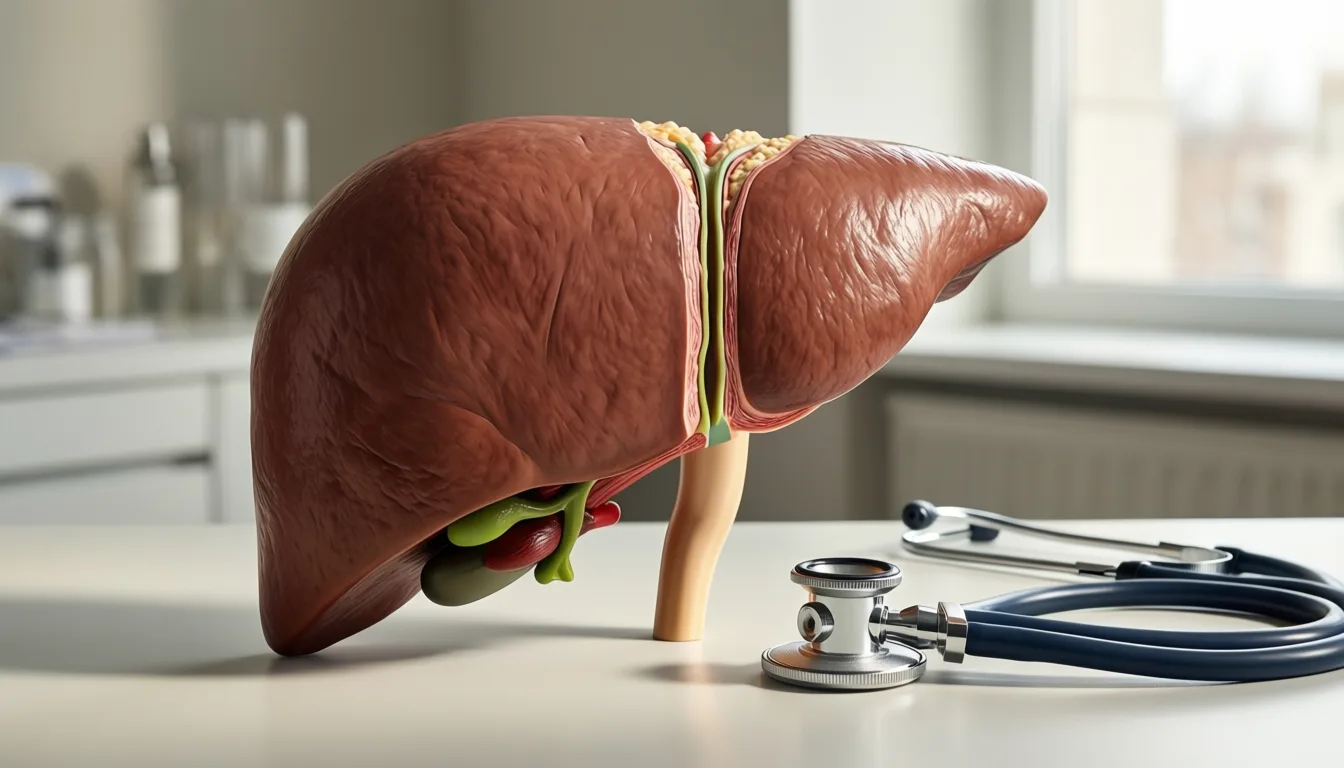
MASH has no approved drug. Combo peptide therapy is the most credible swing at it.
Cardio + GLP-1: the synergy that should interest lifters
Here's where it gets relevant to anyone who actually trains. A 2025 comprehensive review maps the neural circuits and peripheral pathways activated by both endogenous and pharmacological GLP-1, with a specific focus on what happens when you layer aerobic training on top.
The mechanistic picture the authors describe is the kind of thing that makes evidence-minded lifters sit up. Per the review, elevated GLP-1 levels — whether from overexpression models or training-driven signaling — are associated with higher skeletal-muscle glycogen, a shift toward endurance-oriented muscle fibers, increased mitochondrial content, and improved glucose uptake. The review also catalogs GLP-1's documented roles in endurance, muscle recovery, fiber-type distribution, muscle mass, and energy efficiency, alongside effects on bile acids, short-chain fatty acids, L cells, and G-protein-coupled receptors.
Important caveat: this is a review article synthesizing mechanism and animal-plus-human data, not a head-to-head trial of "GLP-1 plus zone-2 cardio" in humans. The authors themselves flag outstanding questions and future challenges in optimizing GLP-1R agonists for cardiovascular disease management. Translation for the gym-floor reader: the biology rhymes, but don't conclude that adding a GLP-1 to your training block is a documented performance stack. It isn't. Yet.
The peptide class is growing up — and the data, while genuinely promising, still asks for a careful read.
The bariatric rebound problem
This one matters because it explains why some people "can't keep it off." A 2025 review in the International Journal of Obesity walks through what happens to endogenous GLP-1 after metabolic bariatric surgery — Roux-en-Y gastric bypass and sleeve gastrectomy in particular — and why those dynamics may dictate long-term outcomes.
According to the review, postprandial GLP-1 rises sharply after these procedures, but fasting GLP-1 doesn't change much. Observational data link higher postprandial GLP-1 to more successful weight loss, and when patients regain weight, adding a GLP-1RA has produced significant additional loss in the studies surveyed. The authors hypothesize that maintaining higher basal-bolus GLP-1RA exposure may be a promising option for patients who plateau or rebound after surgery.
The takeaway isn't "surgery fails." It's that the body's own GLP-1 response appears to be one of the levers that determines durability — and when that lever weakens, pharmacology may be a legitimate rescue rather than a cop-out.

The cardio question isn't whether GLP-1s help — it's how they interact with the work you're already doing.
The oral pill race
Anyone who's done a weekly injection knows the friction. Native GLP-1 has an extremely short half-life and gets shredded by gut proteases, which is why current agonists are subcutaneous and engineered for persistence. A recent protein-engineering paper takes a swing at both problems at once.
The authors computationally designed trivalent fusion proteins that combine a protease-resistant modified GLP-1, a DARPin domain that binds human serum albumin (a known half-life-extension trick), and an approved cell-penetrating peptide. Molecular dynamics simulations and docking flagged one candidate — mGLP1-DARPin-Pen — as the most stable. They cloned it into E. coli, expressed and purified it, confirmed it by SDS-PAGE and western blot, and showed high-affinity binding to human serum albumin. Insulin secretion assays in mouse cells supported the bioactivity premise.
This is early-stage preclinical work — bench validation, not a human trial. But it shows the direction the field is engineering toward: a long-acting GLP-1 you could plausibly swallow. That would change adherence, access, and the conversation around these drugs entirely.
The bigger pattern
Step back and the four threads tell one story. First-generation GLP-1s proved the receptor was a legitimate metabolic lever. The current wave is about extending that lever: combining it with FGF21 to hit the liver, pairing it with training to hit cardiovascular and skeletal-muscle endpoints, using it to rescue post-surgical rebound, and re-engineering it so you don't need a needle.
For the evidence-first lifter, the right posture is the same one that's served you on every other supplement cycle: respect the mechanism, read the trial size, and don't confuse "promising direction" with "settled protocol." The peptide frontier is real. It's just still a frontier.
Frequently asked questions
What did the study combining a GLP-1 drug with efruxifermin actually show?
The phase 2b study found that adding efruxifermin to an existing GLP-1 receptor agonist was safe and well-tolerated in adults with type 2 diabetes and MASH fibrosis, with mostly mild-to-moderate GI side effects and only one discontinuation for nausea. However, it was a 31-person, 12-week safety study, not a fibrosis-reversal trial, so its significance is as proof-of-concept that two metabolic peptides can be layered safely in this patient population.
Does adding a GLP-1 medication improve athletic or gym performance?
The article describes a 2025 review linking elevated GLP-1 levels to higher skeletal-muscle glycogen, a shift toward endurance-oriented muscle fibers, increased mitochondrial content, and improved glucose uptake, but explicitly cautions that this is mechanistic and animal-plus-human data rather than a head-to-head human trial. The article states directly that adding a GLP-1 to a training block is not a documented performance stack.
Why do some patients regain weight after bariatric surgery?
According to a 2025 review cited in the article, postprandial GLP-1 rises sharply after procedures like Roux-en-Y gastric bypass and sleeve gastrectomy, and observational data link higher postprandial GLP-1 to more successful weight loss. When patients regain weight, the authors hypothesize that their endogenous GLP-1 response may have weakened, making pharmacological GLP-1 therapy a potential rescue option.
Is an oral GLP-1 pill available yet?
No — the article describes early-stage preclinical bench work in which researchers computationally designed and lab-validated a trivalent fusion protein candidate intended to resist gut proteases and bind albumin for longer activity, but no human trials have been conducted. The article characterizes this as showing the direction the field is engineering toward, not a product that currently exists.
How strong is the overall evidence discussed in this article?
The article rates the evidence as moderate, noting that most of the research covered is small phase 2 trials, mechanistic reviews, or preclinical work. It describes the findings as a promising direction rather than settled science.
Sources
- Safety and Efficacy of Efruxifermin in Combination With a GLP-1 Receptor Agonist in Patients With NASH/MASH and Type 2 Diabetes in a Randomized Phase 2 Study. — Clinical gastroenterology and hepatology : the official clinical practice journal of the American Gastroenterological Association
- A comprehensive review of GLP-1 and aerobic training in cardiovascular disease management. — Clinical hemorheology and microcirculation
- Post metabolic bariatric surgery weight regain: the importance of GLP-1 levels. — International journal of obesity (2005)
- A new trivalent recombinant protein for type 2 diabetes mellitus with oral delivery potential: design, expression, and experimental validation. — Journal of biomolecular structure & dynamics