Aging Clocks Go Multi-Omics: The Next Generation of Biological Age Tests
Epigenetic age tests were just the prototype. A new wave of clocks stitches together DNA, proteins, metabolites, and microbes — and AI is the thread.
So here's the obvious beginner question: if I already know how old I am, why would I pay someone to tell me again? The answer is that your birthday measures how many times Earth has lapped the sun — not how your cells are actually doing. That second number is what scientists call biological age, and for the last decade they've been trying to read it off your DNA. Now, according to a 2026 review in Aging Cell, the field is leveling up: the next generation of aging clocks doesn't just look at DNA. It looks at almost everything else, too, and lets AI do the math.
Quick gloss before we go further. An aging clock is a tool that estimates biological age from a biological sample. The first famous ones — you may have seen them sold as at-home tests — were epigenetic clocks. They read chemical tags called methylation marks sitting on top of your DNA, kind of like Post-it notes telling genes when to switch on or off. Patterns in those notes change with age in fairly predictable ways, so researchers trained models to guess your age from the pattern. Cool trick. But also a narrow one.
The new review, led by Liu and colleagues, basically argues that one layer of biology was never going to be enough. Aging is messy — it touches your genes, your gene activity, your proteins, your metabolism, even the trillions of microbes in your gut. So the field is pivoting to multi-omics clocks that try to read several of those layers at once and combine them into one number. The authors describe this as a move from epigenetic-based aging prediction toward multi-omics and multi-modal aging clocks.
What "multi-omics" actually means
Think of your body as a building with several floors, and each "-omic" is a different floor plan:
- Epigenomics — the on/off tags on your DNA.
- Transcriptomics — which genes are actively being read right now.
- Proteomics — the proteins those genes produce, doing the real work.
- Metabolomics — the small molecules left over from your body's chemistry (sugars, fats, amino acids).
- Microbiomics — the bacteria living in and on you, especially your gut.
Old-school clocks looked at one floor. Multi-omics clocks try to look at the whole building. The Liu review notes these tools draw on epigenetic, transcriptomic, proteomic, metabolic, and microbial information, together with functional biomarkers — the last bit meaning real-world measurements like grip strength or lung function.
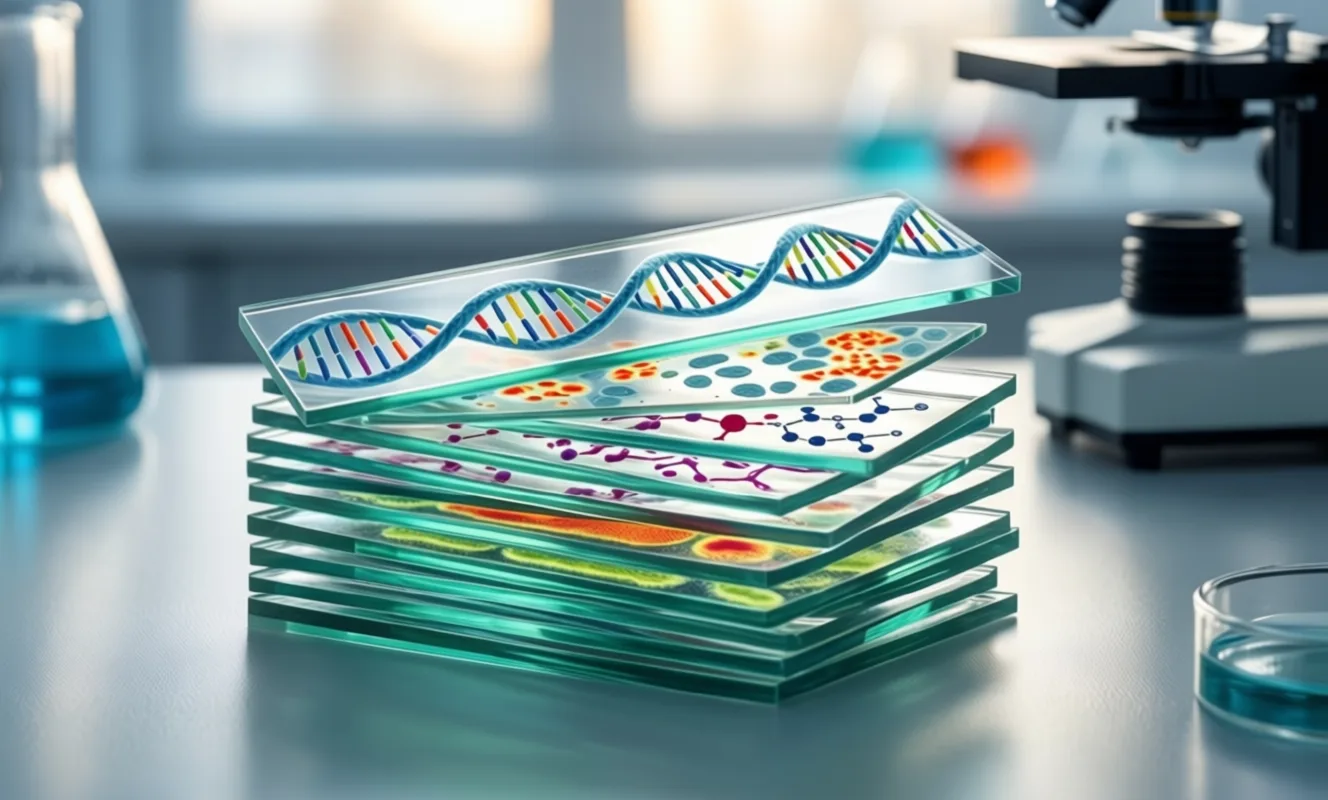
Each "omic" is a different slice of biology. Stacking them gives a fuller picture of how a body is aging.
Why AI changes the math
Here's the catch: stacking five floors of biology gets overwhelming fast. A single blood sample can spit out tens of thousands of data points. No human is going to spot the pattern that says "this 45-year-old's heart is aging like a 55-year-old's." That's where machine learning comes in.
The review describes how ensemble learning and deep learning techniques have become the engine room of modern aging clocks. Ensemble learning means combining the answers of many smaller models — like asking a roomful of specialists and averaging their guesses. Deep learning uses layered neural networks that can find patterns no single specialist would spot. Together, the authors write, these methods can efficiently synthesize and analyze high-dimensional, multi-modal biological data.
Translation: the AI is good at the part humans are bad at — finding faint signals across messy, mismatched data types — and that's what makes a multi-omics clock possible at all.
Your birthday measures how many times Earth has lapped the sun. Biological age measures how your cells are actually doing.
Where this is heading in the clinic
This is where I want to be careful, because the hype train on aging clocks moves fast and the evidence is still catching up. The review's own framing is measured: these tools show significant potential for preventive medicine, early detection of chronic conditions, and tracking whether an intervention (a drug, a diet, an exercise program) is actually moving the needle. "Significant potential" is researcher-speak for promising, not yet routine.
What the authors do claim with more confidence is that the newer, AI-built clocks have made notable progress in terms of accuracy, interpretability, and generalizability compared to earlier generations. Interpretability matters a lot here — an aging clock isn't very useful in a clinic if it can't tell the doctor why it thinks you're aging faster. The newer models are getting better at pointing to which biological layer is driving the score.
Still, this is a review of where the field is going, not a verdict that any specific test is ready for your annual physical. The clocks are inching toward clinical use; they haven't arrived.

The promise: a richer conversation about how you're aging — not a verdict.
- Biological age ≠ chronological age. Clocks try to measure how your body is wearing, not how long you've been around.
- The first wave was epigenetic. It read methylation marks on DNA — one biological layer.
- The next wave is multi-omics. It combines DNA tags, gene activity, proteins, metabolites, microbes, and functional measures.
- AI is the connective tissue. Ensemble and deep learning models stitch the layers together.
- Clinical use is close, not here. Reviewers describe "significant potential" for preventive care and intervention tracking — not routine practice yet.
- Ask before you buy. Direct-to-consumer tests vary widely; talk to a clinician about what a result would actually change.
Frequently asked questions
Is a multi-omics aging clock available at my doctor's office?
Not as a standard test. The 2026 Aging Cell review frames these clocks as showing significant potential for preventive medicine and intervention monitoring — language that signals promising research, not routine clinical use.
What's the difference between an epigenetic clock and a multi-omics clock?
An epigenetic clock reads one layer of biology — chemical tags on your DNA. A multi-omics clock combines several layers, including gene activity, proteins, metabolites, and gut microbes, and uses AI to integrate them.
Why does AI matter for this?
Each "omic" produces thousands of measurements. The review notes that ensemble learning and deep learning are what make it feasible to synthesize this kind of high-dimensional, multi-modal data into a single readout.
Can these tests tell me how to live longer?
Not directly. The review positions them as tools to potentially track whether interventions are working — but which interventions reliably move the clocks, and by how much, is still being worked out. Any lifestyle or medical decisions should involve a clinician.
Should I take an at-home biological age test?
That's a personal call and a good question for your doctor. The science behind clinical-grade multi-omics clocks is advancing, but consumer tests vary in what they measure and how rigorously they've been validated.
The honest takeaway: aging clocks are growing up. They started as a clever DNA trick and are turning into something more like a dashboard — multiple gauges, one integrated readout, AI under the hood. If they live up to the review's framing, the eventual payoff isn't a single magic number telling you when you'll die. It's a tool clinicians can use to spot trouble earlier and tell whether the thing you're already doing — the sleep, the training block, the new medication — is actually helping the cells that matter.
That's a less dramatic story than "reverse your age in 30 days." It's also, refreshingly, a more real one.
Join the conversation
Comments are moderated and reviewed before they appear. Be constructive — this is health information.
Add your comment