
Beyond the Treadmill ECG: Why Cardiopulmonary Exercise Testing Is the New Standard for Health-Optimizers
A 2025 review argues that AI-augmented CPET — measuring how your heart, lungs and metabolism work together — should replace the classic stress ECG as the default deep evaluation. Here is what that shift actually means for your calendar.
The treadmill stress test has been the gold-standard checkup for ambitious, time-poor adults for half a century: walk faster, walk steeper, watch the ECG, go home. It is familiar, it is fast, and — according to a 2025 review in the European Journal of Applied Physiology — it is also increasingly outclassed. The authors argue that cardiopulmonary exercise testing, or CPET, paired with artificial intelligence, should become the default deep evaluation for preventive medicine. For readers who already track sleep stages and HRV, that argument is worth understanding before the next concierge clinic pitches it at a premium.
- What changes: CPET measures the integrated function of your heart, lungs and metabolism in one test — not just the electrical signal of a stress ECG.
- Why now: A 2025 review positions AI-augmented CPET as a candidate replacement for the stress ECG in preventive screening.
- What you get: Numbers like VO2max and ventilatory thresholds that map onto training, recovery and long-term risk conversations.
- The caveat: The evidence base is a review of an emerging field, not a large outcomes trial. Treat it as a directional shift, not a settled standard.
- Action: If a longevity clinic offers CPET, ask who interprets it and how the AI tools are validated — then discuss results with your own clinician.
What a CPET actually measures
A conventional stress ECG asks one question: does your heart's electrical activity stay clean as workload rises? CPET asks a broader one. While you pedal or run, a mask captures every breath, and a metabolic cart tracks how much oxygen you consume, how much carbon dioxide you produce, and how efficiently your body shifts from fat- to carbohydrate-dominant fuel as intensity climbs. The 2025 review describes CPET as a tool that provides comprehensive physiological insights into the integrated function of cardiovascular, respiratory, and metabolic systems, exploiting the interactions between those systems rather than isolating one.
In practice that means a single 30- to 60-minute session yields a panel of numbers — peak oxygen uptake (VO2max), ventilatory thresholds, breathing efficiency, heart-rate response — that together describe how your engine actually works under load. A stress ECG, by comparison, mostly tells you whether the wiring sparks.

CPET captures every breath — the data point a stress ECG cannot see.
Why AI is the part that matters
CPET is not new. What is new — and what drives the review's argument — is the interpretation layer. CPET data is rich, but reading it well has historically required scarce expertise, and two qualified readers can disagree on the same trace. The review notes that AI has introduced a transformative approach to CPET interpretation, enhancing accuracy, efficiency, and clinical decision-making, with potential benefits including improved diagnostic accuracy, reduced interobserver variability and faster decisions.
That last point is the quiet revolution. If algorithms can flatten the expertise gap, a test that once lived in academic cardiopulmonary labs becomes deployable in the kind of preventive clinic an executive might actually visit between meetings. The review frames this as the mechanism by which CPET could plausibly displace the stress ECG as the preferred screening tool in preventive medicine.
A stress ECG tells you whether the wiring sparks. CPET tells you how the whole engine runs.
Reading the evidence honestly
The case here rests on a single high-quality review, not a head-to-head outcomes trial showing that CPET-led screening prevents more heart attacks than stress-ECG-led screening. That distinction matters. The review's own authors flag open issues around data quality, model interpretability, and ethical concerns in deploying AI for CPET interpretation — the standard caveats for any AI-in-medicine story, and reasons to read marketing copy from clinics with a careful eye.
Translation for the calendar-driven reader: the direction of travel is credible, the destination is not yet settled standard of care. If your physician still orders a stress ECG, that is not negligence. If a longevity clinic offers CPET as a premium upgrade, that is not snake oil. Both can be defensible; the right answer depends on what question you are trying to answer about your own physiology.
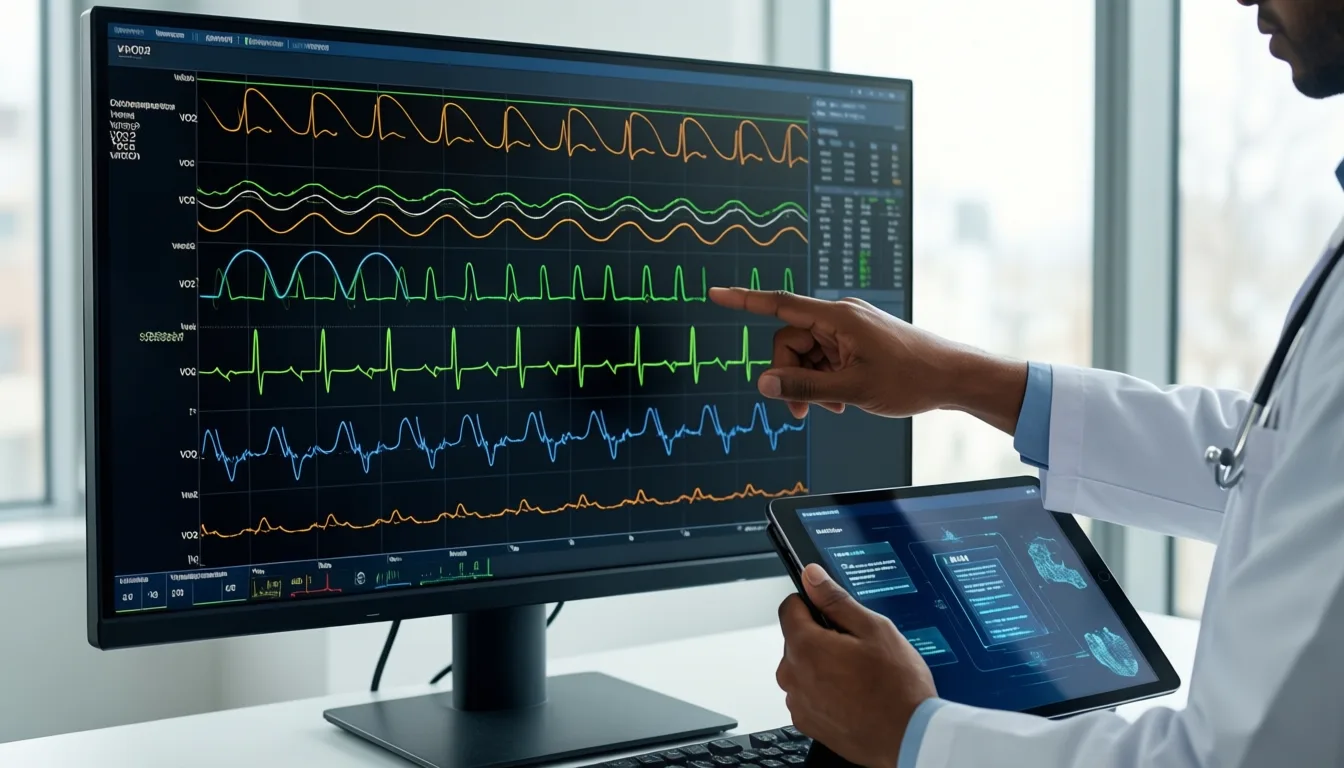
The interpretation layer — not the treadmill — is where the field is moving fastest.
What to ask before you book
The bottom line for optimizers
For readers who already treat sleep, training load and bloodwork as quarterly KPIs, CPET is a logical next instrument: it produces metrics — VO2max chief among them — that connect cleanly to the way endurance athletes and longevity-minded physicians already talk about capacity and risk. The 2025 review's contribution is to make the case that, with AI in the loop, this richer test is finally practical at preventive-medicine scale rather than reserved for elite sports science or advanced cardiology referrals.
Treat the shift as moderate-strength evidence pointing in a sensible direction. The treadmill stress ECG is not obsolete tomorrow morning. But if the next time you book a deep cardiac evaluation, your clinician offers CPET with a clearly explained interpretation workflow, the science now supports taking that option seriously — and asking better questions about what the numbers mean for the next decade of your calendar.
Frequently asked questions
What does CPET measure that a standard treadmill stress ECG does not?
While a stress ECG monitors the heart's electrical activity as workload rises, CPET uses a mask and metabolic cart to track oxygen consumption, carbon dioxide production, and how efficiently the body shifts between fuel sources. A single 30- to 60-minute session produces metrics like VO2max, ventilatory thresholds, breathing efficiency, and heart-rate response that together describe the integrated function of the cardiovascular, respiratory, and metabolic systems.
Why is AI specifically what makes CPET more practical now?
CPET itself is not new, but interpreting its rich data has historically required scarce expertise, and two qualified readers can disagree on the same trace. The 2025 review argues that AI can improve diagnostic accuracy, reduce interobserver variability, and speed up decisions — flattening the expertise gap enough to make CPET deployable in preventive clinics rather than only in academic cardiopulmonary labs.
Does the article say CPET is now the standard of care for preventive screening?
No. The case rests on a single review, not a head-to-head outcomes trial showing that CPET-led screening prevents more heart attacks than stress-ECG-led screening. The article describes the shift as "moderate-strength evidence pointing in a sensible direction" and notes that a physician who still orders a stress ECG is not being negligent.
What questions should I ask a clinic before booking a CPET?
The article recommends asking who interprets the results (a board-certified physician with CPET experience should sign off), which AI tools are used and how they are validated, and how the findings would actually change your plan — whether that means adjustments to training, follow-up imaging, or a referral. It also advises bringing the report to your regular clinician so results feed into your broader medical care.
Why does the article say VO2max is particularly relevant for health-optimizers?
VO2max is described as the chief metric CPET produces, and one that connects directly to the way endurance athletes and longevity-minded physicians already discuss capacity and long-term risk. For readers who already track sleep, training load, and bloodwork, the article frames CPET as a logical next instrument because its outputs map onto those existing conversations.
Sources
- Transitioning from stress electrocardiogram to cardiopulmonary exercise testing: a paradigm shift toward comprehensive medical evaluation of exercise function. — European journal of applied physiology
Join the conversation
Comments are moderated and reviewed before they appear. Be constructive — this is health information.
Add your comment