Rewriting the mTOR Aging Playbook: From YTHDF1 to Curcumin
Two new studies sharpen the picture of mTOR as an aging lever — pointing toward more precise ways to dial it down than blunt suppression.
For nearly two decades, longevity science has circled the same molecular switch. mTOR — the mechanistic target of rapamycin — is the cellular dial that tells your tissues whether to grow or to recycle, to build or to repair. Quiet it, and lab animals live longer. Quiet it too much, and you risk side effects no healthy 60-year-old wants to sign up for. Now two papers, one published in Molecular Cell in 2025 and the other in Cells in 2024, are sketching a more interesting possibility: that mTOR is less a single switch than a panel of dials, and that we may be learning where to put our fingers.
- mTOR is not one lever. New work suggests its aging effects come from distinct sub-pathways that may be targetable separately.
- An RNA-binding protein called YTHDF1 appears to sit on the lysosome and quietly restrain mTORC1 — and losing it accelerated aging in mice.
- Curcumin extended lifespan in yeast cells with damaged mitochondria, working in part by inhibiting TORC1.
- This is early evidence. One study is in mice, the other in yeast. Neither is a green light for human supplementation.
- The bigger idea: more precise mTOR modulation, not blanket suppression, may be the next chapter in longevity research.
The lysosomal gatekeeper nobody was watching
If you have followed longevity research at all, you know the rapamycin story: a drug skimmed from soil bacteria on Easter Island that, by inhibiting mTOR, extends lifespan in mice and is now studied — cautiously — in humans. The problem has always been one of precision. mTOR governs protein building, cholesterol synthesis, immune function, wound healing. Suppress the whole network and you slow aging; you may also slow things you would rather not.
A 2025 paper in Molecular Cell from a team led by Bin Liu and colleagues offers a finer-grained view. The researchers report that a protein called YTHDF1, best known as a reader of m6A chemical tags on RNA, has a second, completely separate job: it anchors to the surface of the lysosome — the cell's recycling compartment — via a partner called LAMP2, and from that perch it recruits a braking complex (TSC2) that holds mTORC1 in check.
When the team deleted YTHDF1 in mice, the brake came off. mTORC1 activity surged down a specific branch — the SREBP2-driven cholesterol biosynthesis pathway — while protein-synthesis pathways were spared. The mice aged faster, and their maximum lifespan was shortened. Rapamycin partially rescued healthspan, confirming mTORC1 as the culprit.
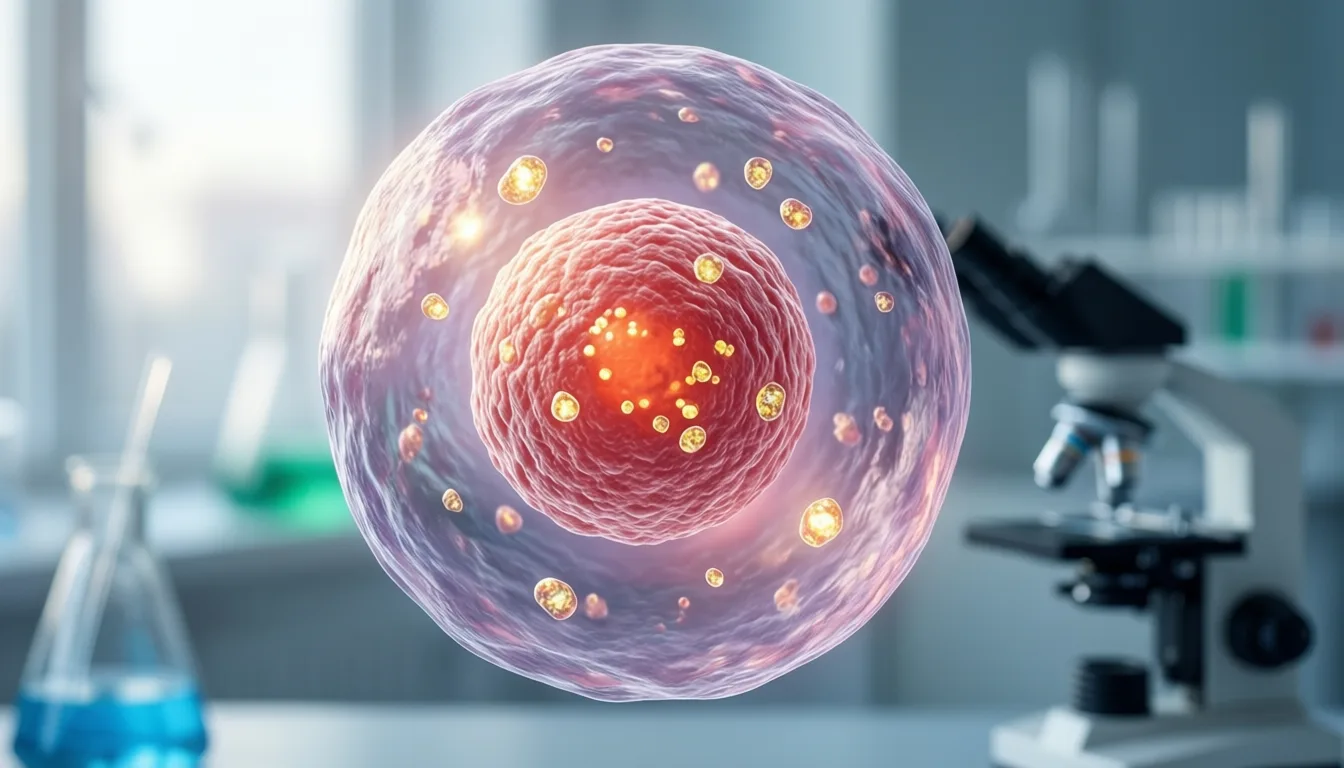
The lysosome — long cast as the cell's garbage disposal — is emerging as a regulatory hub where signals about aging are integrated.
mTOR is less a single switch than a panel of dials — and we may be learning where to put our fingers.
Why this matters beyond mouse biology
The conceptual shift is the headline here. For years, researchers have spoken of mTORC1 as if its many downstream outputs rose and fell together. The YTHDF1 work suggests otherwise: lose one regulator and you can selectively dial up cholesterol synthesis without touching translation. That is the kind of dissociation drug developers dream about, because it implies you might one day quiet the aging-relevant arm of mTOR without paying the price on the metabolic arms you depend on.
A caveat worth holding onto: this was a mouse study, with mechanism worked out in cells. It tells us something real about mammalian biology, but the leap to a human therapy — let alone a supplement — is long. What the work does, persuasively, is reframe the target.
Curcumin, mitochondria, and the lifespan of a yeast cell
Now switch organisms. In a 2024 paper in Cells, Alfatah and colleagues asked a more modest question: does curcumin — the yellow pigment in turmeric, beloved of supplement aisles and just as often dismissed by clinicians — actually do anything measurable to cellular aging?
They used a yeast model of postmitotic cellular lifespan, which is a useful proxy for how long non-dividing cells (think neurons, cardiac muscle) stay viable. Curcumin extended that lifespan in healthy yeast, with the strongest effect at lower concentrations — a classic hormetic curve, where less is more and too much loses the benefit. Crucially, it also extended the lifespan of yeast with engineered mitochondrial dysfunction, a finding that matters because mitochondrial decline is one of the load-bearing features of aging.
The mechanism the authors converged on: curcumin inhibits TORC1 (the yeast equivalent of mTORC1), raises ATP levels, and induces a controlled dose of oxidative stress that appears to trigger protective responses.
Curcumin's lifespan effect in yeast was strongest at low doses — a hormetic pattern that complicates the more-is-better logic of supplementation.
What the two papers share — and what they don't
Read together, the two studies make a single quiet point: mTOR/TORC1 sits at a hub where aging signals converge, and the field is starting to find more selective ways to nudge it. YTHDF1 hints at endogenous regulators we did not know existed. Curcumin hints that compounds already on kitchen shelves may act on the same hub — though, importantly, the yeast data say nothing about what curcumin does inside a 60-year-old human at any particular dose.
What they do not share is evidence strength. The YTHDF1 paper is mammalian and mechanistic. The curcumin paper is in yeast. Curcumin's bioavailability in humans is notoriously poor; large clinical trials have produced mixed results across various indications, and there is no human lifespan data — there cannot be, yet.
The playbook, rewritten
The first generation of mTOR longevity science asked a simple question: what happens if we turn the dial down? The second generation, which these two papers belong to, is asking a better one: which part of the dial, and how gently?
That is a more honest framing for readers who have lived long enough to be wary of magic bullets. It also points to a near future in which the conversation about aging is less about a single blockbuster pill and more about a layered set of interventions — some pharmaceutical, some dietary, some not yet invented — each tuned to a specific node in the network. YTHDF1 and curcumin are, for now, two coordinates on that emerging map.
Neither is a finish line. Both are reasons to keep reading.
Frequently asked questions
What is mTOR and why do researchers care about it for aging?
mTOR — the mechanistic target of rapamycin — is described as a cellular dial that tells tissues whether to grow or recycle, to build or to repair. Quieting it extends lifespan in lab animals, but suppressing the whole network can also slow biological processes you would rather keep intact. New research suggests mTOR is less a single switch than a panel of dials, raising the possibility of more selective interventions.
What did the YTHDF1 study find, and what happened to mice that lacked this protein?
The 2025 Molecular Cell study found that YTHDF1, previously known as an RNA reader protein, has a second job: it anchors to the lysosome surface and recruits a braking complex that holds mTORC1 in check. When YTHDF1 was deleted in mice, mTORC1 activity surged specifically through a cholesterol biosynthesis pathway while protein-synthesis pathways were spared, the mice aged faster, and their maximum lifespan was shortened.
What did the curcumin study show about lifespan in yeast?
The 2024 Cells paper found that curcumin extended postmitotic cellular lifespan in yeast, with the strongest effect at lower concentrations — a hormetic pattern where less is more and too much loses the benefit. It also extended lifespan in yeast engineered to have mitochondrial dysfunction, and the proposed mechanism involved inhibiting TORC1, raising ATP levels, and inducing a controlled dose of oxidative stress.
Do these studies mean people should take curcumin for longevity?
No — the article is explicit that neither study establishes that a human can extend healthspan by taking curcumin. The curcumin data come from yeast cells, curcumin's bioavailability in humans is described as notoriously poor, large clinical trials have produced mixed results, and there is no human lifespan data. The article states that any conversation about supplements or off-label drugs for longevity belongs with a clinician.
How do the two studies differ in terms of scientific evidence strength?
The article notes they do not share the same evidence strength: the YTHDF1 paper is mammalian and mechanistic, conducted in mice with mechanism worked out in cells, while the curcumin paper is in yeast. The article describes the overall evidence as early and cautions that neither study is a green light for human supplementation.
Join the conversation
Comments are moderated and reviewed before they appear. Be constructive — this is health information.
Add your comment