What Happens to Your Cholesterol When You Stop Drinking
A massive Japanese cohort study tracked the exact moments adults quit — or started — drinking, and watched their LDL and HDL move in opposite directions.
The sober-curious era keeps producing the same hopeful headline: quit drinking, and almost everything in your bloodwork gets better. Liver enzymes relax. Sleep deepens. Resting heart rate drifts down. But cholesterol — the marker most of us actually get tested every year — turns out to be a more complicated story. A new analysis of more than 300,000 annual checkups in Tokyo caught thousands of adults at the precise moment they started or stopped drinking, and tracked what happened next inside their lipid panels. The answer is not a clean win. It is a trade-off, and it's worth understanding before your next dry January.
- Quitting alcohol nudged LDL (the "bad" cholesterol) up and lowered HDL (the "good" cholesterol) in a large Japanese cohort.
- Starting to drink did the opposite — LDL dipped, HDL rose — a mirror image that strengthens the causal read.
- The shifts were modest, not dramatic, and measured outside of clinical trials, on people simply showing up for annual checkups.
- Cardiovascular risk is bigger than any single lipid number; alcohol's net effect on the heart is still net-negative in most current evidence.
- If you're changing your drinking, tell your clinician — and consider re-checking lipids a few months later.
The study that caught people mid-change
Most of what we know about alcohol and cholesterol comes from either short, tightly controlled feeding studies or from big observational snapshots that compare drinkers to non-drinkers at a single point in time. Both have limits. The newer work, published in JAMA Network Open, took a different angle: it followed the same people across years of annual physicals at a Tokyo preventive-medicine center, and zeroed in on the visits where a person's drinking status had actually changed between one checkup and the next.
That design matters. Instead of asking who drinks and who doesn't, it asks: when a specific person stops drinking, what does their LDL and HDL do over the next year? The cohort spanned 328,676 visits from 57,691 individuals between 2012 and 2022, with anyone on lipid-lowering medication excluded so the signal wouldn't be muddied by statins.
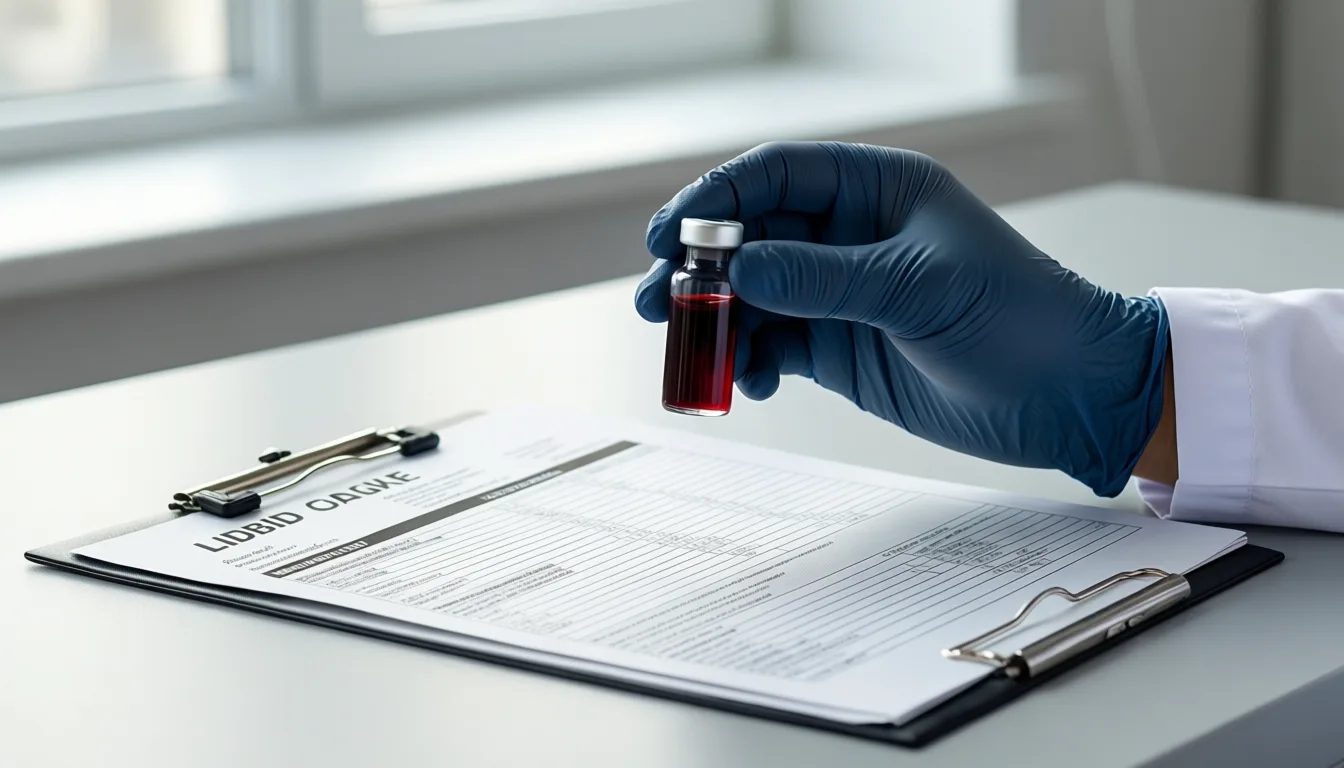
The study used routine annual bloodwork — the same panels most adults get — rather than specialized trial measurements.
What actually moved, and by how much
Among roughly 25,000 participants whose drinking habits shifted between visits, stopping alcohol was associated with a rise in LDL-C of about 1.10 mg/dL in people who had been light drinkers, with larger shifts among those who had been drinking more heavily. HDL-C — the fraction long flagged as cardioprotective — moved the other way, dropping when people quit. Initiating alcohol produced a roughly mirror-image pattern: LDL eased down a touch, HDL ticked up.
Two things are worth holding in mind. First, these are average shifts across a very large group; an individual reader could see more, less, or none of this. Second, the magnitudes are modest. A change of one to a few mg/dL in LDL is not, on its own, the difference between health and disease — it sits well inside the noise of any single lab draw. What makes the numbers interesting is the consistency of direction across thousands of people captured at the exact moment of behavioral change.
Quitting didn't "fix" cholesterol. It rearranged it — LDL up, HDL down — a trade-off the headlines rarely mention.
Why HDL goes down when you stop
The HDL piece is the part that surprises people, because the cultural script around quitting is that every number improves. But the alcohol-raises-HDL relationship has been documented for decades and is one of the more biologically consistent effects of ethanol on the lipid system. When the input goes away, the output it was propping up tends to recede. The Tokyo cohort simply quantified that drift in a real-world, non-trial setting.
The harder question — one this study does not resolve — is whether alcohol-driven HDL is the same as endogenously high HDL from exercise, genetics, or diet. Researchers have been chipping away at that for years, and a growing body of work suggests HDL is less a single "good cholesterol" number than a family of particles whose function matters as much as their quantity. Translation: a higher HDL produced by a nightly glass of wine is not automatically a reason to keep pouring.
The sober-curious shift has made non-alcoholic drinks mainstream — but the metabolic picture is more nuanced than "every number improves."
The bigger picture your lipid panel can't see
It would be easy to read these results as a defense of moderate drinking. They aren't. The lipid panel is one window into cardiovascular risk, but alcohol also raises blood pressure, disrupts sleep architecture, contributes to liver fat, and — at the population level — is now firmly linked to several cancers. Recent public-health reviews have moved away from the old "a little is protective" framing precisely because the non-lipid harms accumulate even at modest intakes.
So the honest read of the new data is narrower than the headline suggests. Stopping alcohol does not deliver a uniformly prettier lipid panel; it produces a small LDL bump and a small HDL dip on average. That is useful information if you're the kind of person who watches their numbers and wants to understand a year-over-year change without panicking. It is not a reason to keep drinking for your heart.
What this changes — and what it doesn't
The evidence here is moderate, not definitive. It's a single (large) observational cohort from one country, with a population that skews healthier than average simply because they show up for annual preventive checkups. Causality is suggested by the mirror-image pattern of initiation and cessation, but not proven. What the study does well is give us a real-world estimate, in real people, of a shift that has mostly been described in tightly controlled trial settings.
For readers reconsidering their relationship with alcohol — whether that's a dry month, a permanent goodbye, or just a quieter weekday routine — the takeaway is less dramatic than the internet would like. Your liver will likely thank you. Your sleep tracker probably will too. Your cholesterol panel will shuffle in a small, predictable way that is worth knowing about so you don't misread it as something more alarming. The bigger heart-health verdict on alcohol has been written elsewhere, and it has not gotten kinder with time.
Your liver will thank you. Your sleep tracker will too. Your lipid panel will shuffle — quietly, predictably, and worth knowing about.
Frequently asked questions
Does quitting alcohol improve all of my cholesterol numbers?
Not necessarily. The Tokyo cohort found that stopping alcohol was associated with a small rise in LDL (the "bad" cholesterol) and a drop in HDL (the "good" cholesterol), rather than across-the-board improvement. The article describes this as a trade-off that headlines about quitting alcohol rarely mention.
How large were the cholesterol changes seen after people stopped drinking?
The changes were modest. Stopping alcohol was associated with an LDL rise of about 1.10 mg/dL among light drinkers, with larger shifts seen in heavier drinkers. The article notes that a change of one to a few mg/dL in LDL is not, on its own, the difference between health and disease.
Why does HDL drop when someone stops drinking?
The alcohol-raises-HDL relationship has been documented for decades and is described in the article as one of the more biologically consistent effects of ethanol on the lipid system. When that input goes away, the HDL it was propping up tends to recede.
Does the HDL dip from quitting mean people should keep drinking for their heart?
The article says no. Alcohol also raises blood pressure, disrupts sleep, contributes to liver fat, and is linked to several cancers, and recent public-health reviews have moved away from the "a little is protective" framing. The article explicitly states the study data is not a defense of moderate drinking.
If my LDL rises after I stop drinking, what should I do?
The article recommends telling your clinician if you are changing your drinking habits and considering re-checking your lipids a few months later. It also advises waiting at least a few months after a behavior change before drawing conclusions from a single lab draw, since lipids fluctuate.
Join the conversation
Comments are moderated and reviewed before they appear. Be constructive — this is health information.
Add your comment