In This Issue
Longevity
-
 Can Physical Resilience Outrun Your Genes? A Swedish Cohort Says Maybe
In more than 3,000 older adults, a clever measure of bounce-back capacity blunted the mortality penalty of inheriting genes for a shorter life — a moderate but provocative signal for the fitness-forward crowd.
Can Physical Resilience Outrun Your Genes? A Swedish Cohort Says Maybe
In more than 3,000 older adults, a clever measure of bounce-back capacity blunted the mortality penalty of inheriting genes for a shorter life — a moderate but provocative signal for the fitness-forward crowd.
-
 The Fitness You Bring to a Virus: What Cooper Clinic Data Says About COVID and Staying Strong
A rare prospective study with pre-pandemic treadmill scores shows infection nudges fitness downward — and the men who started lower had the hardest recoveries.
The Fitness You Bring to a Virus: What Cooper Clinic Data Says About COVID and Staying Strong
A rare prospective study with pre-pandemic treadmill scores shows infection nudges fitness downward — and the men who started lower had the hardest recoveries.
-
 The Biological Age Era: How Epigenetic Clocks and Immune Maps Are Rewriting Risk
DNA-methylation clocks and a new atlas of immune aging are nudging longevity science from theory toward something a clinic could actually use. Here's where the evidence really stands.
The Biological Age Era: How Epigenetic Clocks and Immune Maps Are Rewriting Risk
DNA-methylation clocks and a new atlas of immune aging are nudging longevity science from theory toward something a clinic could actually use. Here's where the evidence really stands.

Can Physical Resilience Outrun Your Genes? A Swedish Cohort Says Maybe
In more than 3,000 older adults, a clever measure of bounce-back capacity blunted the mortality penalty of inheriting genes for a shorter life — a moderate but provocative signal for the fitness-forward crowd.
For years, the longevity conversation has swung between two poles: the genetic determinists, who treat your inherited odds as a verdict, and the lifestyle optimists, who insist enough deadlifts and zone-two cardio can rewrite the script. A new analysis from a long-running Swedish aging cohort offers something more interesting than either camp's slogan. It suggests that physical resilience — the capacity to bounce back from the small and large insults of aging — can meaningfully blunt the mortality risk carried by genes predisposing you to a shorter life. Not erase. Blunt. And that distinction matters.
The study, drawn from the Swedish National Study on Aging and Care in Kungsholmen (SNAC-K), followed 3,041 adults aged 60 and older and asked a specific question: does physical resilience offset the mortality cost of a polygenic risk score for shorter survival? The researchers operationalized resilience in a clever way — not as raw fitness, which conflates the healthy with the lucky, but as residual gait speed: how fast you walk relative to what would be predicted given your chronic diseases, medications, and sociodemographic profile. In other words, are you outperforming the version of you that statistics expect? That residual is the resilience signal.
The framing is important because it sidesteps a familiar confound. A 75-year-old who walks briskly may simply have fewer diseases; that is not resilience, that is good fortune. By stripping out the expected contribution of the medical chart and asking what is left over, the SNAC-K team isolated something closer to the trait fitness optimists have long claimed exists: an underlying capacity to absorb stressors without collapsing.
What the numbers actually say
Participants were sorted into low, moderate, and high physical resilience tiers based on how far their gait speed sat from the predicted value. The team then layered in a polygenic risk score for shorter lifespan and tracked mortality. The headline finding: physical resilience was independently associated with survival, and it appeared to attenuate the mortality risk associated with a higher genetic predisposition to die earlier. Put plainly, two people carrying similar unfavorable genetic loads did not face identical futures; the more resilient walker fared better.
It is worth pausing on what this is and is not. This is a single observational cohort in a relatively homogenous Swedish urban district, with resilience measured at one baseline visit between 2001 and 2004. It is not a randomized trial of an intervention. No one was assigned to become resilient. We are looking at an association, carefully constructed, in a population that has been followed long enough to produce a meaningful mortality signal — which is exactly why it earns a moderate evidence rating rather than a stronger one.
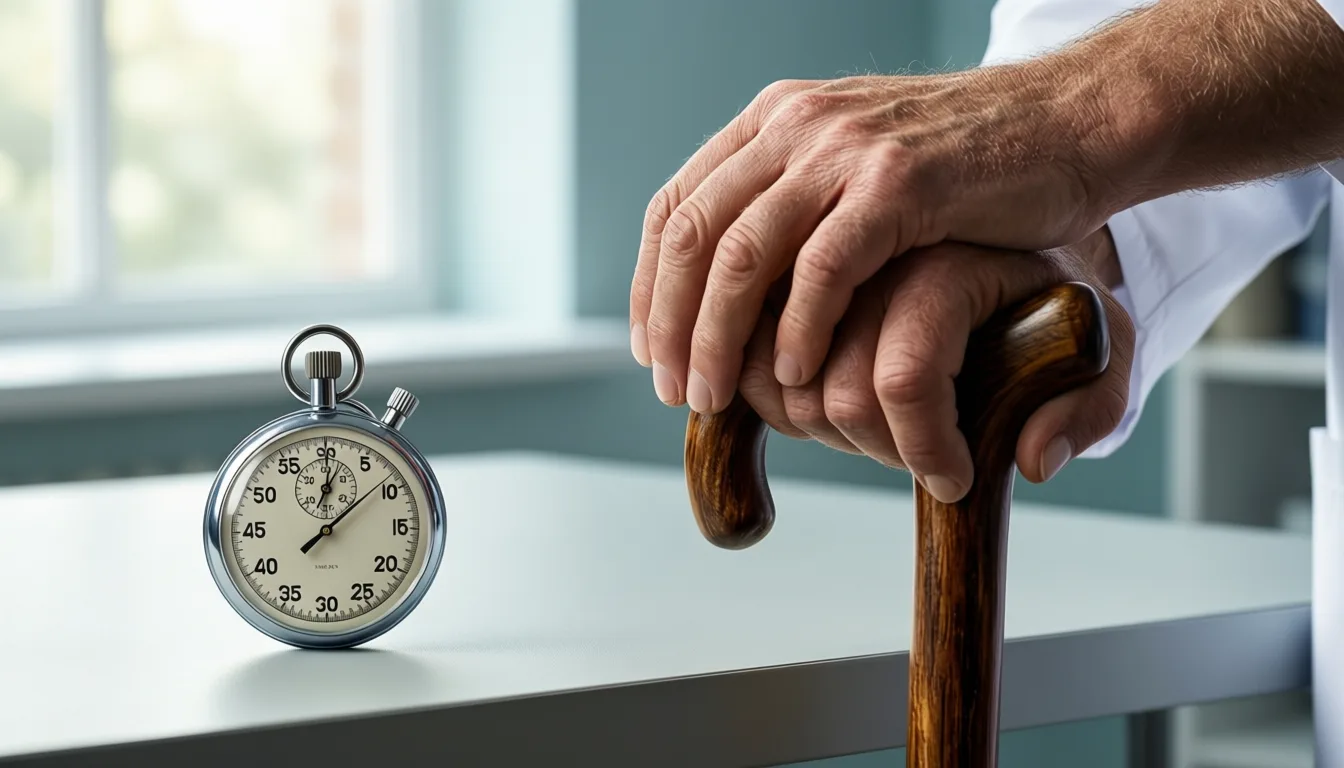
Residual gait speed — your pace versus the pace your medical chart would predict — is a deceptively simple proxy for something deeper.
Why residual gait speed is more interesting than gait speed
Gait speed has been called the sixth vital sign in geriatrics, and for good reason: it integrates neurological, muscular, cardiovascular, and cognitive function into a single, embarrassingly cheap measurement. But raw gait speed rewards the already-healthy. The SNAC-K team's move — predicting a person's expected pace from their diseases, drugs, age, sex, and education, then asking how far above or below that line they walk — is what turns a vital sign into a resilience metric. It is the gap between expectation and performance that seems to carry the prognostic weight.
This is also why the finding resonates with the broader longevity literature without overstepping it. Plenty of work has linked physical activity, muscle quality, and cardiorespiratory fitness to longer life. What is novel here is the explicit test of whether that capacity can interact with genetic risk — and the suggestion that the answer is yes, at least directionally.
Two people carrying similar unfavorable genetic loads did not face identical futures. The more resilient walker fared better.
What this does and doesn't license you to believe
The temptation, especially for readers who already track their VO₂ max and grip strength, will be to read this as vindication: train hard, override your genes, live forever. That is not what the data say. What they say is more modest and, frankly, more useful. Genetic predisposition to a shorter lifespan is real and measurable. So is physical resilience. The two appear to interact such that the second can soften the first. The size of that softening, the durability of it across populations less affluent and less Scandinavian than SNAC-K's, and the mechanisms behind it — muscular, metabolic, neurological, or something more systemic — all remain open questions.
There is also a chicken-and-egg problem the authors are appropriately careful about. Residual gait speed reflects whatever the medical chart cannot see: undiagnosed disease, subtle frailty, mood, motivation, social engagement. Some of that may itself be partly heritable. The resilience signal is real; its causal architecture is not fully nailed down.

SNAC-K participants live in one Stockholm district; whether the findings generalize is the next question.
The practical translation
If you are looking for an actionable read, it is this: a measure designed to capture the capacity to bounce back — not raw athletic output, not absence of disease, but performance relative to expectation — tracks with surviving longer even when your genes are pulling the other way. That is consistent with a growing body of work suggesting that the trainable components of aging matter, and it adds a specific mechanism-adjacent claim to the pile: resilience as a buffer, not just a correlate.
What it is not is a prescription. The study did not test an exercise program, a supplement, or a protocol. It observed people and measured an outcome. Anyone wanting to translate the signal into a personal plan — particularly older adults with existing conditions — should do that conversation with a clinician who knows their chart.
- The signal: In 3,041 older Swedes, higher physical resilience was linked to lower mortality and appeared to blunt the risk carried by a polygenic score for shorter lifespan.
- The metric: Resilience was measured as residual gait speed — pace relative to what diseases, medications, and demographics would predict.
- The strength: Moderate. One well-constructed observational cohort, not a randomized trial; associations, not proven causation.
- The nuance: Residual gait speed captures more than fitness — possibly mood, social engagement, undiagnosed disease — so the mechanism remains open.
- The takeaway: Genes set odds; they do not set verdicts. Trainable capacity appears to matter even when the inherited deck is unfavorable.
- The caveat: Findings come from one Stockholm cohort; generalizability across populations is the next test.
The longevity field has a habit of overclaiming its early signals and then quietly walking them back. This finding deserves neither breathless reframing nor dismissal. It is a careful, well-designed observational result that adds a piece to a puzzle many readers of this magazine are already assembling: that the gap between your genetic baseline and your actual aging trajectory is wider, and more workable, than the determinists suggest — and narrower, and more contingent, than the optimists sometimes promise.
Frequently asked questions
What is 'residual gait speed' and why did the researchers use it instead of plain walking speed?
Residual gait speed is how fast a person walks compared to the pace their medical chart — accounting for chronic diseases, medications, age, sex, and education — would predict. The researchers preferred it over raw gait speed because a brisk walker may simply have fewer diseases, which reflects good fortune rather than resilience; the gap between expected and actual pace is what isolates the resilience signal.
What did the study actually find about physical resilience and genetic risk?
Among the 3,041 older adults followed, higher physical resilience was independently associated with longer survival and appeared to blunt — not erase — the mortality risk carried by a polygenic score predisposing someone to a shorter lifespan. Two people with similar unfavorable genetic profiles did not face identical futures; the more resilient walker fared better.
How strong is the evidence from this study?
The article rates it moderate. The SNAC-K cohort is a single observational study — not a randomized trial — conducted in one Stockholm district, with resilience measured at one baseline visit between 2001 and 2004, so the findings show associations rather than proven causation and may not generalize to other populations.
Could residual gait speed be capturing things other than physical fitness?
Yes, the article notes this explicitly. Residual gait speed can reflect factors the medical chart does not capture — mood, social engagement, undiagnosed disease, and subtle frailty — some of which may themselves be partly heritable. The resilience signal is described as real, but its causal architecture is not fully established.
Does the study recommend a specific exercise program or supplement to improve resilience?
No. The study observed people and measured outcomes; it did not test any exercise program, supplement, or protocol. The article states that anyone wanting to translate the findings into a personal plan should have that conversation with a clinician who knows their medical history.
Sources
- Physical Resilience May Offset Mortality Risks Associated With Genetic Predisposition to Shorter Survival: A Population-based Cohort Study. — The journals of gerontology. Series A, Biological sciences and medical sciences
The Fitness You Bring to a Virus: What Cooper Clinic Data Says About COVID and Staying Strong
A rare prospective study with pre-pandemic treadmill scores shows infection nudges fitness downward — and the men who started lower had the hardest recoveries.
For most of the pandemic, we were arguing about it with incomplete numbers. Did the virus actually shave something off the engine, or were people just deconditioned from a long stretch on the couch? The honest answer, until recently, was that almost nobody had a good before-and-after picture. Treadmill tests done in 2018 don't tend to sit in a drawer waiting to be useful in 2023. At the Cooper Clinic in Dallas, they happened to. And what those serial measurements show is quieter than the headlines but, for men our age, more useful.
The Cooper Center Longitudinal Study followed just over four thousand adults between 2017 and 2023 who had their cardiorespiratory fitness measured at least twice on a maximal treadmill protocol. Roughly forty-two percent reported a bout of COVID along the way. A small slice — about five percent of those infected — reported symptoms that dragged on past three months, the working definition of long COVID. Because the clinic had pre-pandemic fitness scores on file, the researchers could ask a question most studies could not: what did these people look like, aerobically, before the virus found them?
The answer is the part worth sitting with. The men and women who later developed long COVID were already starting from a lower rung. Their baseline fitness averaged ten metabolic equivalents, compared with about eleven for those who recovered uneventfully and for the uninfected. That's not a dramatic gap on paper, but in treadmill terms it's the difference between comfortably finishing a stage and reaching for the handrail. The finding held up after the authors adjusted for the usual suspects.
What the treadmill actually saw
Every group lost a little ground over the study window — roughly two-tenths of a metabolic equivalent, which is about what you'd expect from the slow tax of aging. The infected lost a hair more than the uninfected, on the order of a tenth of a MET. That's a real, statistically detectable signal, and it's also a small one. By long COVID status, the additional decline didn't reach statistical significance, partly because only eighty people in the cohort met that definition. The authors are careful about that limitation, and so should we be.
Two things can be true at once. The virus does appear to leave a small aerobic footprint, on average, in people who get it. And the people who arrived at the infection with less fitness in the bank were the ones who struggled longest afterward. Whether that's because lower fitness causes worse outcomes, or because whatever conditions dragged fitness down in the first place also predisposed people to a rougher course, the data here cannot fully separate. This is a moderate piece of evidence, not a verdict.

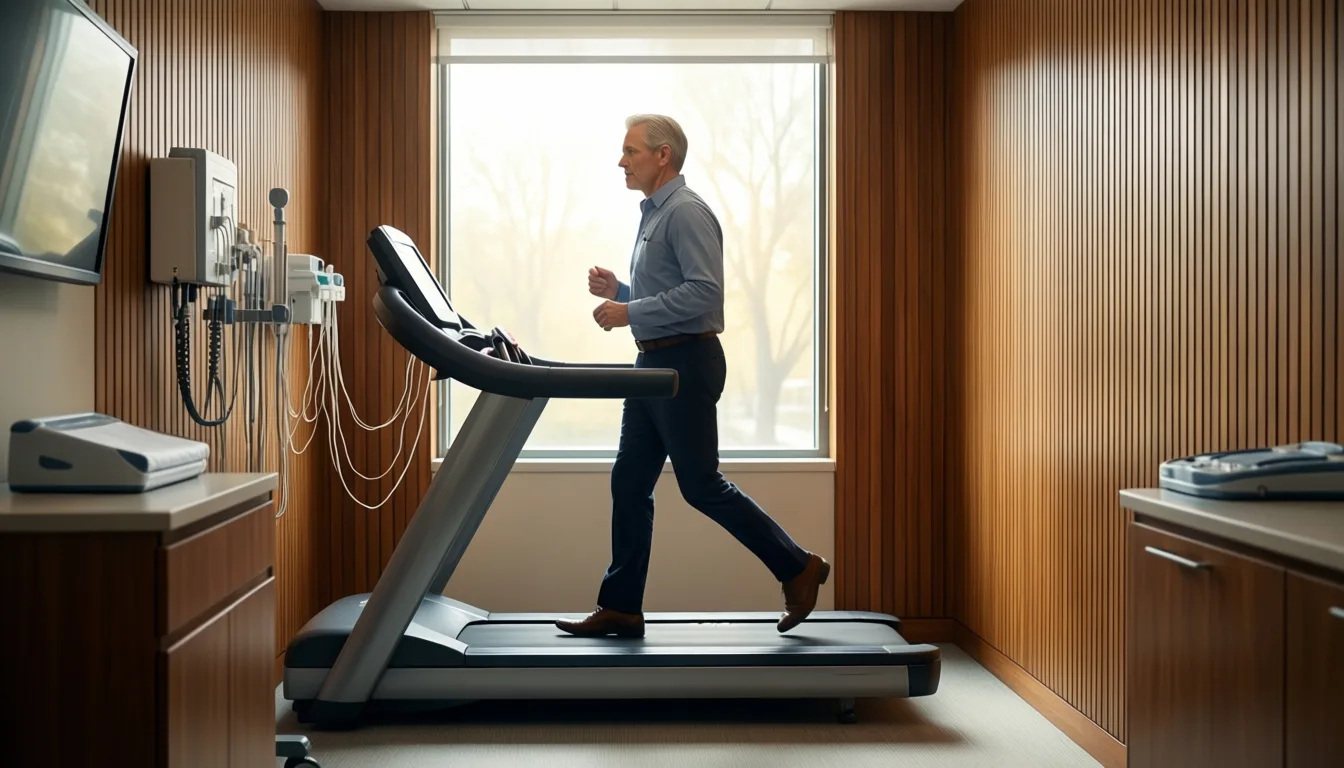
Serial treadmill tests, taken years apart, gave researchers something most pandemic studies lacked: a real before.
The men who arrived at the infection with less in the tank are the ones still climbing back.
Why this matters past sixty
Cardiorespiratory fitness has been one of the more reliable predictors of how long, and how well, a person lives. The Cooper group has spent decades building that case in their own cohort. What this newer analysis adds is a stress test, in the literal sense: when a novel virus came through, the people with more aerobic capacity took the hit better. That's the practical takeaway for a reader in his sixties or seventies. Fitness is not a shield against infection. It looks, instead, like a shock absorber.
It's also one of the few resilience assets you can still build at our age. Muscle responds. The cardiovascular system responds. The pace of gain is slower than it was at forty, and the soreness lasts longer, but the trajectory bends. A man who can comfortably hold a brisk walk up a moderate grade is operating at roughly the fitness level that separated the recovered from the long-haulers in this study. That is not nothing, and it is not out of reach for most people who haven't been told by a clinician to hold back.
- Baseline fitness mattered. Participants who later reported long COVID had measurably lower pre-infection treadmill scores.
- The infection penalty was real but small. Infected adults lost about a tenth of a MET more than the uninfected over the study window.
- Long COVID's extra decline didn't reach significance — only eighty people in the cohort met that definition, so read the result with appropriate humility.
- Everyone declined a bit. About two-tenths of a MET across all groups, the ordinary tax of years.
- Fitness behaves like a buffer, not a shield. It doesn't prevent infection; it appears to soften what the infection costs you.
- Talk to your clinician before changing exercise intensity, especially after a recent infection.

The fitness range that separated the recovered from the long-haulers is within reach of most steady walkers.
What to read carefully, and what to skip
A few cautions before anyone files this under settled science. COVID status was self-reported, which means some people in the "uninfected" group almost certainly had the virus and never knew. The cohort skews healthier and more affluent than the country at large — this is a preventive medicine clinic in Dallas, not a public hospital. And the long COVID subgroup is small enough that the study can describe it but not fully explain it. The authors flag these limits plainly, which is the right way to publish a finding of this size.
None of that erases the signal. The direction of the data lines up with what cross-sectional studies have been hinting at for years, and it does so with a study design that's hard to come by. For a reader weighing whether to keep up the walking, the resistance work, the boring consistency of it all, this is another modest piece of evidence on the side of yes.
The Cooper data won't be the last word on this. Larger cohorts with pre-infection fitness measurements will eventually clarify what this study could only suggest. But the through-line is consistent with what longevity research has been telling us for a long time, in plainer language than the journals tend to use: the work you put in before you need it is the work that pays you back when something goes wrong. A treadmill score from 2018 turned out to be a useful thing to have in 2023. The same will likely be true of the walk you take tomorrow morning.
Frequently asked questions
What did the Cooper Clinic study find about fitness levels in people who later developed long COVID?
People who went on to develop long COVID already had lower cardiorespiratory fitness before they were ever infected, averaging 10 metabolic equivalents on the treadmill test compared with about 11 for those who recovered uneventfully and for those who weren't infected at all. The finding held up after the researchers adjusted for other factors.
How much aerobic fitness did people actually lose over the course of the study?
Every group in the study lost about two-tenths of a metabolic equivalent over the study window, which the authors describe as roughly what you'd expect from the ordinary effects of aging. People who were infected lost approximately a tenth of a MET more than the uninfected, a real but small difference.
Did people with long COVID show a significantly greater decline in fitness than those who recovered normally?
The additional fitness decline in the long COVID group did not reach statistical significance. The authors note this is partly because only about 80 people in the cohort met the long COVID definition, and they flag that limitation plainly.
Does being fit protect you from catching COVID in the first place?
According to the article, fitness is not a shield against infection. It appears instead to act like a shock absorber — people with more aerobic capacity took the hit better when the virus came through, but fitness did not prevent infection.
What are the main limitations the researchers acknowledged about this study?
COVID status was self-reported, meaning some people counted as uninfected likely had the virus without knowing it. The cohort also skews healthier and more affluent than the general population, since this was a preventive medicine clinic rather than a public hospital, and the long COVID subgroup was small enough that the study could describe it but not fully explain it.
Sources
- Association of Pre-COVID Fitness With Post-COVID Fitness and Long COVID in the Cooper Center Longitudinal Cohort Study. — Journal of the American Heart Association

The Biological Age Era: How Epigenetic Clocks and Immune Maps Are Rewriting Risk
DNA-methylation clocks and a new atlas of immune aging are nudging longevity science from theory toward something a clinic could actually use. Here's where the evidence really stands.
Here's a question I keep coming back to: why do two people born the same year sometimes feel like they're living in totally different bodies? One is hiking at 70. The other is winded climbing stairs at 55. Same candles on the cake, wildly different insides. Scientists have been chasing that gap for years — and a new wave of research suggests we might finally have tools that can actually see it. Not perfectly. Not yet. But enough to start asking better questions about how each of us is aging.
Okay, beginner question first: what even is a "biological age"? Think of it this way. Your chronological age is just the number of trips you've taken around the sun. Your biological age is more like the wear-and-tear readout on your cells — how your body is actually holding up. The hot tool for measuring that readout right now is called an epigenetic clock. And no, it doesn't tick.
Epigenetics is basically the sticky notes your body leaves on your DNA telling it which genes to turn up or down. As we age, the pattern of those notes — specifically tiny chemical tags called methyl groups — shifts in predictable ways. Researchers trained algorithms to read those patterns and spit out a number: your estimated biological age. A 2025 review in the Journal of Clinical Medicine walks through the main contenders — Horvath, PhenoAge, GrimAge, and DunedinPACE — and where each one actually earns its keep.
Meet the clocks (they each do a different job)
It helps to think of these clocks less like a single bathroom scale and more like a panel of specialists. Horvath was the OG — it nailed chronological age across tissue types and proved the whole concept was real. PhenoAge and GrimAge went a step further: instead of just guessing your birthday, they were built to predict things you actually care about, like risk of mortality, cardiovascular trouble, and cognitive decline. DunedinPACE is the newest twist — it estimates the pace at which you're aging right now, like a speedometer rather than an odometer. According to the review, the second-generation clocks (GrimAge, PhenoAge, DunedinPACE) consistently outperform the originals when the goal is predicting future health outcomes.
Alongside the clocks, the review highlights a related toolkit called EpiScores — methylation-based readouts tied to specific things like inflammation, blood-sugar control, and immune aging. The pitch: instead of one big "how old are you really" number, you get a more granular dashboard of risk signals that could plug into preventive care, longevity clinics, or even national checkup systems. The authors specifically flag Japan's "Aging Measurement" project at the Osaka-Kansai Expo 2025 as an early real-world experiment in doing exactly that.
Different clocks, different jobs — and they don't always agree on what time it is.
The other half of the story: your immune system is aging too
Here's the thing the clocks can hint at but can't fully explain on their own: why some people's bodies start to falter. A big part of the answer, increasingly, is the immune system. A 2025 review in Immunity pulls together the current picture of human immune aging, and it's genuinely fascinating — partly because the field has leveled up its tools.
For decades, scientists looked at immune cells with flow cytometry, which is sort of like sorting M&Ms by color through a narrow funnel. Now, with single-cell sequencing and advanced cytometry, they can describe each cell in detail — like reading the wrapper, not just the color. The authors of the Immunity review map how the major immune compartments change with age, both in the bloodstream and in tissues, and where the older and newer methods agree, disagree, and reveal new wrinkles.
The big takeaway, in plain English: aging doesn't just "wear down" your immune system — it rewires it. Some cell populations expand, others shrink, and the functional effects accumulate well before anything obviously breaks. That matters because it suggests there's a window where we can see dysfunction taking shape before it becomes disease. Which is exactly the window preventive medicine wants to live in.
Aging doesn't just wear down your immune system. It rewires it — and the rewiring starts long before anything breaks.

The immune system as a network: aging shifts the pattern, not just the strength.
So… should you go order a clock test?
This is where I have to put on my honest-friend hat. The science is exciting and the evidence is real, but the editorial rating on this story is Moderate for a reason. Both reviews are essentially saying "we have promising tools and a much clearer map than we did five years ago." They are not saying "go check your GrimAge every quarter and act on the number." The review authors themselves call out the need for global standardization and ethical guardrails before these tools are ready for routine clinical decisions.
What seems most usable right now is the framing: chronological age is a blunt instrument, and your biological trajectory is something measurable — even if exactly which measurement to trust is still an open question. If your clinician brings up an epigenetic test as part of a research program or longevity workup, that's a real conversation worth having. If a wellness influencer is selling you one with a confident regimen attached, slow down. The science isn't there yet.
- Biological age ≠ chronological age. Epigenetic clocks try to measure the wear-and-tear, not the birthdays.
- Second-generation clocks do more work. GrimAge, PhenoAge, and DunedinPACE are built to predict outcomes like mortality and cognitive decline, per the 2025 review.
- EpiScores add granularity. Think inflammation, glycemic control, and immunosenescence as separate dials, not one big number.
- Immune aging is being remapped. Single-cell tools are revealing how immune populations shift with age in both blood and tissues.
- Clinical readiness is partial. Both reviews flag standardization, validation, and ethics as the next big hurdles.
- Talk to a clinician. This is a fast-moving research space, not a DIY protocol.
The honest summary: we're at the stage where the toolkit is starting to look usable, but the instruction manual is still being written. The epigenetic clocks can see something chronological age can't. The new immune-aging map gives us a much better sense of why bodies diverge. Put them together and you get the outline of a future where "risk stratification" actually means something personal — not your age bracket, but your trajectory. That future isn't here yet. But for the first time, it's close enough to plan for.
Frequently asked questions
What is the difference between biological age and chronological age?
Chronological age is simply the number of years you have been alive, while biological age is more like a wear-and-tear readout on your cells — how your body is actually holding up. Epigenetic clocks attempt to measure biological age by reading the pattern of chemical tags called methyl groups that shift on your DNA as you age.
What are the main epigenetic clocks and what sets the newer ones apart?
The main clocks covered in the 2025 review are Horvath, PhenoAge, GrimAge, and DunedinPACE. Horvath was the original and proved the concept by estimating chronological age across tissue types, while the second-generation clocks — GrimAge, PhenoAge, and DunedinPACE — were built to predict things like mortality risk, cardiovascular trouble, and cognitive decline, and consistently outperform the originals when the goal is predicting future health outcomes.
What makes DunedinPACE different from the other clocks?
DunedinPACE estimates the pace at which you are aging right now, rather than giving a fixed biological age number. The article describes it as functioning like a speedometer rather than an odometer.
What are EpiScores and how do they differ from a single biological age number?
EpiScores are methylation-based readouts tied to specific risk signals such as inflammation, blood-sugar control, and immune aging. Instead of producing one big biological age number, they offer a more granular dashboard of separate dials, which the article suggests could plug into preventive care or national health checkup systems.
Is it a good idea to order an epigenetic clock test on your own right now?
The article urges caution, noting that the review authors themselves call for global standardization and ethical guardrails before these tools are ready for routine clinical decisions. It distinguishes between a clinician-led conversation in a research or longevity workup context — described as worth having — and a wellness influencer selling a test with a confident regimen attached, which the article advises slowing down on.
Sources
- Epigenetic Clocks and EpiScore for Preventive Medicine: Risk Stratification and Intervention Models for Age-Related Diseases. — Journal of clinical medicine
- Human immune aging. — Immunity